People vs. Michael Jackson: Vitiligo
Dr. Qiyasi on Friday night, on the program “Friday Night Show” on the satellite channel “TV Persia One,” made statements about Michael Jackson that were the result of his lack of knowledge about the realities of Michael Jackson’s life. These facts are no longer hidden from anyone, and we’re very surprised that Dr. Qiyasi is so unaware of them!
He said that if he were in Michael Jackson’s place, he would have spent those millions of dollars helping the world instead of changing his skin color, altering his face, and doing plastic surgery. It’s hard to believe that he hasn’t heard anything about a disease that removes skin color or about vitiligo, and that he hasn’t read anything about Michael Jackson’s charitable actions to improve other people’s lives. Michael Jackson suffered from a skin condition called vitiligo. This disease has a prevalence of about 1% worldwide, and millions of people have it. The disease appears in different forms in different individuals—mild in some, severe in others. Michael Jackson and Lee Thomas, the Fox show host, are among the famous people who have this condition.
In the following, you can see a photo of Thomas. He has written a book titled “Whitening.” The photo on the right was taken earlier. At the top of the photo, you can see that his hand is completely colorless. In the next photo, you can observe the progression of the disease in his forehead area. And in the photo on the left, you can see that he uses makeup to cover the white spots.
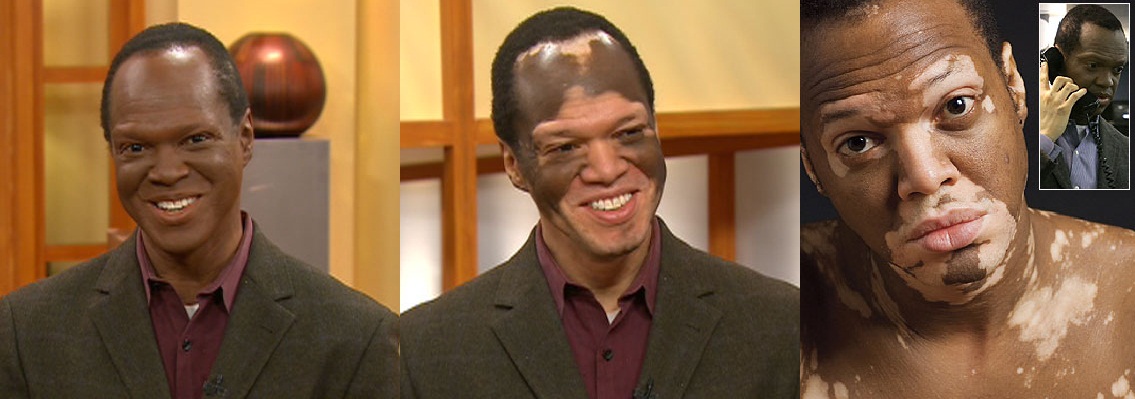
Lee Thomas’s way of dealing with this disease is similar to what Michael Jackson chose. From the early 1980s, Michael’s skin color became lighter and lighter. Michael told his mother, Katherine, that he didn’t want to look like a spotted cow. He used the term “spotted cow” to refer to cows that are half black and half white. For this purpose, Michael would hide the white spots that appeared on his face and body with darker makeup. But this treatment works only as long as the white skin spots can be covered. When your body is turning from black to white, the first thing is to prevent the disease from progressing and to do something to cover the white surfaces. The disease may progress to the point where you turn from black skin with white spots into white skin with black spots. That’s when a specialist doctor will suggest treatment with lasers or chemical substances. This is a way to even out skin color and remove the remaining limited black-colored spots once your skin has become mostly white.
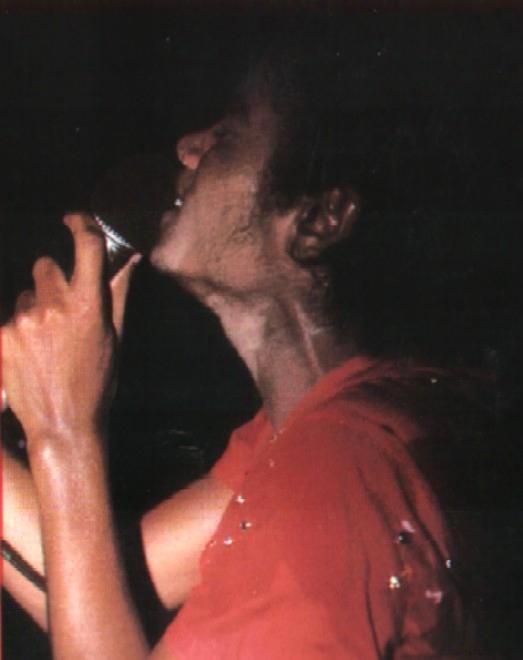
This disease has been seen in people of every race. You’ve surely encountered something like this on a bus, in a store, among relatives, and in many other places. Mothers and fathers teach their children not to stare at others, not to ask them about their illness, not to judge them, and not to avoid them. If you have this disease, it is a choice of nature—not your fault—and no one has the right to harm you or bother you. Having vitiligo is not a flaw or defect; it’s only a skin disease. No physical pain or complications, but full of psychological suffering.
If you’re a celebrity—so much so that a few people on television are willing to host you, like Lee Thomas—then be sure that the spots on your skin will become more attractive to people because of the way you perform. You become their “spotted” host. The very person Lee Thomas says scared a little girl in the street just by the spots on his skin. Thomas decided to stop using makeup. He endured judgment and pitying looks and allowed the cameras to zoom in on the spots on his face and body. Now he is an image of this disease.
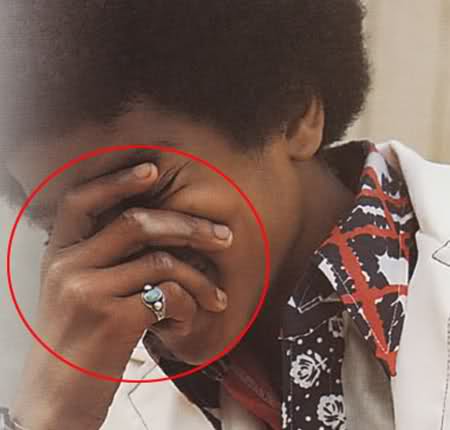
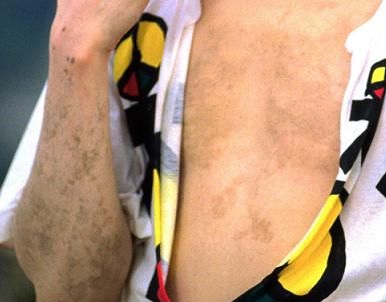
Of course, years earlier—when no one yet knew anything about vitiligo—Michael had introduced this disease to the world. Perhaps many people, upon hearing his words about his pain and suffering, and even his lack of interest in talking about the illness more than a few sentences, breathed a sigh of relief that they weren’t alone in this world—and that the most famous person of that era was also suffering from their condition. But we must say that some never heard Michael Jackson’s words, and didn’t believe them— not even the legendary Quincy Jones, who collaborated with Michael on the Off the Wall, Thriller, and Bad albums, and after Michael’s death called his statements a fictional story. However, forensic medicine, by examining Michael’s body, wrote that he had vitiligo.
If Michael’s defense of himself was censored by the media, then his death and his murder trial created so much noise in the media that everyone should have heard the truth about vitiligo by now… but apparently some people still haven’t heard it—including Dr. Qiyasi. Of course, maybe he knows the truth too, but for some reason he has fallen into this misunderstanding that incorrect and wrong statements are more appealing to the public and thus become more “popular.”
At least one third of Michael Jackson’s wealth was spent on charitable work. According to his will, 20% of his fortune will go after his death to charitable organizations. With his charity foundation, Heal The World (“Heal the World”), he helped the victims of the war in Bosnia and, during the years of his activity, saved thousands of children from death. These are only small examples of Michael Jackson’s great work during his lifetime. In the end, we’ll only add this: according to Guinness World Records, Michael Jackson is the most charitable male pop artist (Pop Star) and has supported more charities than other artists. He is the most charitable member of the TJ Martell Institute, which works against AIDS.
Beyond all this, what the media says about Michael Jackson’s multiple plastic surgeries—and has always been used as a pretext to insult and harass him and his fans—is nothing more than a myth. First, a person’s desire to undergo plastic surgery is a personal matter, and no one has the right to interfere in it or judge that person. Look at the two photos below and compare them with the media’s claims about Michael Jackson’s many surgeries, and then judge for yourselves.
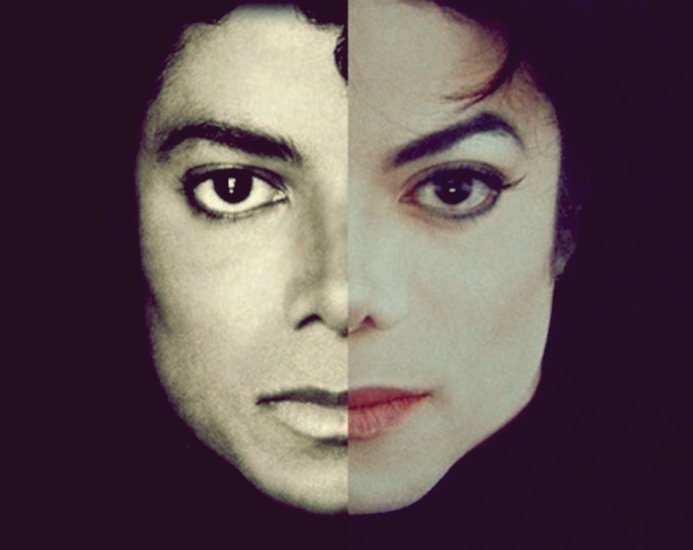
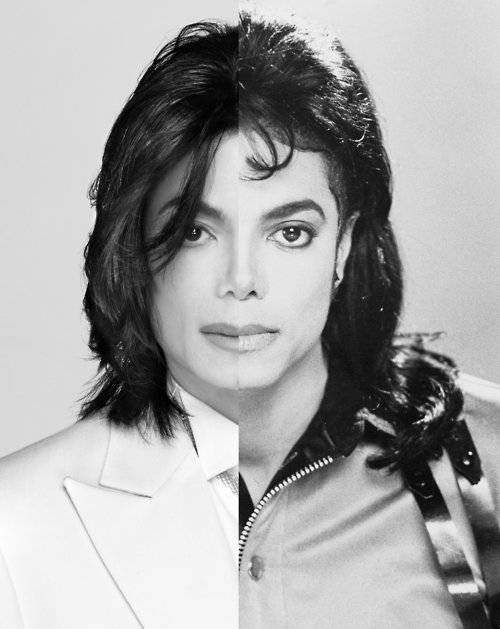
Talking about Michael Jackson’s humanitarian help to people of every race, recognizing his vitiligo disease, and freeing him from the shackles of racial accusations may be the only thing we can do as a sign of gratitude and respect for his admirable human qualities.
For this purpose, we invite you dear friends to inform Dr. Qiyasi of the facts about Michael Jackson by emailing
Thank you for your support
eMJey.com