


December 18, 2003 - 60 Minutes on CBS
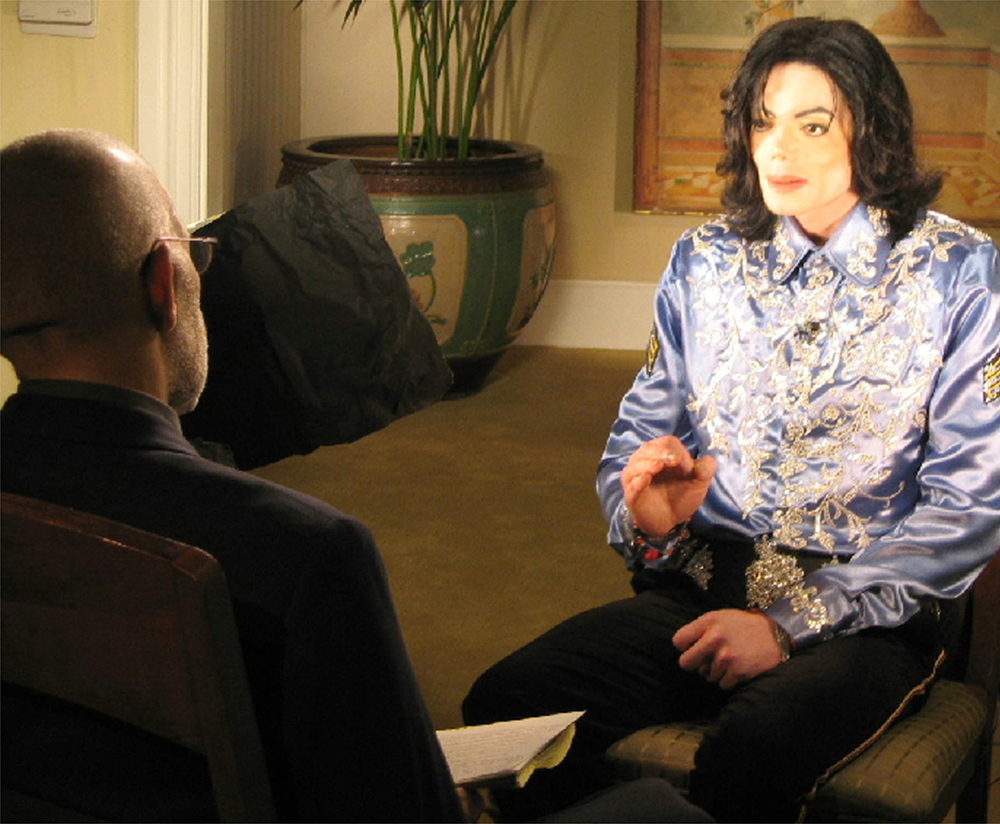
This is the first exclusive interview Michael has given since the allegations were made against him regarding child abuse. The interview will air at 7 p.m. ET on January 7 on CBS. The interview took place on Thursday, January 4, at a hotel in Los Angeles.
For most of his life, Michael Jackson, the King of Pop, has been the subject of intense curiosity about his extraordinary musical talent—and, in recent years, about his unusual behavior. Two weeks ago, his life may have reached its darkest moment yet, when he was formally accused of sexually abusing a 13-year-old boy, suffering from cancer, and being a friend of Michael. If the charge is proven, he could face a 20-year prison sentence. He is currently out on bail, and tonight Michael Jackson makes his first public appearance to speak about his arrest, the man who accused him, and the allegations against him. We met him at Christmas time at a hotel in Los Angeles—one of several cities where he has been staying in isolation since the complaint was filed by officials in Santa Barbara.
Ed Bradley: What is your response to the allegations brought by the Santa Barbara district attorney—allegations that you sexually abused a boy?
Michael Jackson: They’re all lies. Before I ever abuse a child, I’ll cut my own wrist. I never abuse children. It’s all lies. I’m very, very angry. I could never do something like that.
Ed: Did you know the boy?
Michael: Yes.
Ed: How would you describe your relationship with him?
Michael: I’ve helped so, so, so many children—thousands of children, children with cancer, children with leukemia. This one is one of those.
Ed: So when did he come around? What was he doing? What were you doing?
Michael: I’ll tell you exactly. The first time I saw (...) his head was completely shaved—white as snow from chemotherapy—very bony, like people who suffer from a lack of appetite. He didn’t have eyebrows or eyelashes, and he was very weak. I had to carry him from the house to the playroom, or push him in a wheelchair, so I could give him a childhood—a life—because I felt bad, because I myself never had that kind of opportunity, you know? That’s why I knew what it felt like to be in that situation. Not because he was sick, but because he didn’t have a child. That’s why my heart goes out to children like that—I feel their pain. I had never really climbed a tree. I have a tree at Neverland that I named “the Giving Tree,” because I enjoy writing lyrics on it and I’ve written a lot of songs on it. So I told him, “You have to climb the tree. That’s part of being a boy. You just have to do it.” And I helped him climb, and when he got up there, we looked down from up in the tree through the branches—and it was so beautiful, so magical, and he loved it. To give him a chance at life, you know what I’m saying? Because he had been told he was going to die. He had been told. His parents had been told they needed to prepare for his funeral—that’s how bad it was. And I made plans for him. I helped many people do that, and I put him under a kind of mental program.
(A quote from the child from an English documentary program: “One night, I asked him if I could stay in his bedroom, and he said yes. I said, Michael, you can sleep on the bed, and he said no, no—he sleeps on the bed. And then at the end he said, okay, if you love me, you’ll sleep on the bed, and I said, oh man, and that’s how I ended up sleeping on the bed and he slept on the floor.”)
Ed: When they were taking you to the police station, with handcuffs on your wrists so they could take pictures—what was going through your mind? That your pictures were going to be shown all over the world.
Michael: They did it to try to make me small, to take away my pride. But I went through it with them until the end, and in the end I wanted the public to know that I was okay—even though I was suffering.
Ed: What happened when they arrested you? What did they do to you?
Michael: They were supposed to just come in, take fingerprints, and do whatever they do with someone they arrest. They treated me very roughly. My shoulder was dislocated. It really hurts—I’m in pain the whole time. You can see it here, can’t you? You can see my arm? I can’t move it any more than this from here. It’s like this on this side, too—up to here.
Ed: Because of how they treated you at the police station?
Michael: Yes, yes. At the police station. If you—if you saw what they did to my arm, they were very rough. It’s very swollen. I don’t want to say it—you’ll see it yourself. You’ll see.
(Pictures were provided to us that were said to have been taken after Michael was released on bail. Jackson says the swelling is above his ankle, where the police put the handcuffs.)
Ed: How did they do it? I mean, what physically did they do?
Michael: With the handcuffs, with the force they used to strap them very tightly to my back.
Ed: On your back?
Michael: Yes, and they put it in a particular position they knew would be very painful and would affect my back. I can’t move now—it won’t let me sleep at night. I can’t sleep at night. After that, I asked for permission to go to the bathroom, and they said, “Sure, it’s right around the corner.” The moment I walked into the bathroom, they locked the door, and they kept me there for about 45 minutes. It was disgusting—feces all over the walls, the floor, the ceiling—and it smelled terribly. Then a police officer came over by the window and said something sarcastic. He said, “Smell it—does it smell good enough for you? How does it smell? Is it good?” And I just said, “It’s fine, no problem.” I just sat there and waited.
Ed: For 45 minutes?
Michael: Yes, for 45 minutes—almost 45 minutes. And then another police officer came over and said, “Oh, you’ll be out in a minute. You’ll be out in a minute.” Then another ten minutes passed, and then another 15 minutes. They did it on purpose.
(The district attorney, Thomas Sneddon, said that Jackson was treated fairly and justly while he was in custody. He rejected our request for an interview, as did the sheriff’s department captain Jim Anderson, whose deputies issued the search warrant for Neverland.)
Ed: What did it feel like when they entered Neverland with a search warrant? What were they looking for? What did they take?
Michael: My room was completely a wreck. My workers told me. They said, “Michael, don’t go into your room.” They were crying on the phone, my employees. They said, “If you saw your room, you’d be crying.” I have a staircase to my room upstairs, and they said, “You can’t even go up the stairs. The room has been turned into a junkyard.” They came into this bedroom with eighty police officers. Eighty police officers in one bedroom. That’s excessive. They brought knives and cut open the mattresses, cut everything, and opened everything.
Ed: Did they take anything from Neverland?
Michael: I don’t know if they took anything. They never gave me an inventory.
Ed: But you’re saying they destroyed your things?
Michael: Yes, that’s right. They kicked everyone out who worked in that area. They took over the whole house so they could do whatever they wanted, and they really took advantage of the opportunity. They went into places they weren’t allowed to go, like my workplace. They weren’t allowed to search those areas. And they really abused it. And I was told that the room was completely, completely destroyed. I don’t think I want to see it. I’m not ready to see it yet.
Ed: So you haven’t gone back there yet?
Michael: I’ve been back there, but not to my bedroom. I’ll never live there again. Now it’s a house—it’s not a home. I’ll only go there to see it. What time is it? Because I’m in pain. You know? I’m in pain. Anyway, I have to go soon. I don’t feel well.
(Michael Jackson stayed with us long enough to tell us why sleeping with children is not inappropriate, and long enough to take a hit at the family whose child accused him of sexual abuse. This isn’t the first time Michael Jackson has faced such an allegation. Ten years ago, he was accused as well, but he was never put on trial. After receiving a large sum of money, the boy dropped the complaint. The family involved in the recent incident never filed a lawsuit, and it’s been said they had no intention to do so—but Michael Jackson does not pay money.)
Michael: Greed got into this matter, and someone... me, I can’t say exactly, but it’s about money. It’s Michael Jackson’s case. Look what we have here. We can get money out of him. That’s exactly what happened.
Ed: You helped him with his cancer. What I don’t understand is why today, I know you say it’s about money—but if that isn’t true, why does he come back and say, “Michael Jackson sexually abused me”?
Michael: Because parents have power over their children. They feel they have to do what their parents tell them. But love of money is the root of all evil. He’s a sweet child, and when you see how this happens, he’s not like that. That’s not him.
Ed: So you don’t think it was his doing?
Michael: No.
Ed: And it came from his parents?
Michael: It wasn’t his doing. I know his heart.
Ed: When the allegations were brought against you in 1993, were you cleared of those allegations at that time?
Michael: Yes.
Ed: So if you were innocent, why did you pay money to make them be quiet? I mean, why didn’t you go to court and fight for your name?
Michael: I’m not allowed to talk about this.
A man’s voice: For a moment, I’m going to stop your work.
Ed: Okay.
(Michael’s powerful attorney, Mark Geragos, told me that if I wanted an answer to this question, I should ask him.)
Mark Geragos: I mean, remember what happened to him ten years ago—he was humiliated. He got to a point where everyone was watching him. They took pictures of him, they humiliated him to the point of looking at his private areas and photographing those little spots. And he went through the worst interrogations you can imagine. I can only try to put myself in that situation and say, look, if money can take that situation away from me, then let it be. That’s how it was. I don’t know, and I don’t want to make another decision about it.
Ed: But the way society has processed this is that it didn’t happen once—it happened twice. Those young boys have come forward in the last ten years and talked about how much he enjoyed sharing his bed with children. You understand how society might feel about this. Hey, maybe it’s a story. A lot has been said.
Mark: Well, look, a lot has been said, but many of the people who comment twist what happened. I understand when people say someone else came forward. But I think if we’re fair, most people understand. Most people understand that this case is nothing but money.
(We asked the child’s mother to describe the story from her perspective, but she refused and wouldn’t allow anyone to speak on her behalf.)
Ed: That English documentary program that you didn’t like...
Michael: Yes, I didn’t like it.
Ed: In that documentary you said that many children slept in your bedroom. You said—and I want to quote you—“Why can’t you share your bed? It’s a sweet thing to share your bed with someone.”
Michael: Yes.
Ed: Now that we’re sitting here today, do you still think it’s acceptable to share your bed with children?
Michael: Of course, why not? If you’re a child molester, you’re Jack the Ripper* or a murderer—that’s not a good idea, and I’m not. That’s how we were raised. And I didn’t sleep with that child. If I did sleep, it wasn’t anything special. I slept on the floor, and I gave the bed to the child.
(* Jack the Ripper: the nickname of a killer who, in 1888 in London, was linked to at least seven women and whose case became one of the most famous unsolved mysteries in English criminal history—so in people’s minds he remains an example of a killer.)
Ed: You’re a father. You have three children.
Michael: Yes.
Ed: Do you allow your children to sleep on the bed with an adult man who isn’t your relative, or do you allow them to sleep in their bedroom?
Michael: Of course—if I know the person, if I trust them, and if they like them. That happened to me many times when I was a kid.
Ed: As a father, do you allow your children to sleep in a bedroom with someone who is suspected or accused of things that have been alleged against you and said about you today? Do you allow that?
Michael: Someone...
Ed: If you knew someone who had similar allegations...
Michael: Ed, I understand what you’re saying.
Ed: ...that were brought against you... would you allow your children...
Michael: My children?
Ed: ...to sleep in a man’s bedroom?
Michael: If I knew the person personally. Because I know how newspapers are, and how people can twist the truth. If I knew the person personally, then of course yes. I didn’t have a problem with it.
Ed: Do you know how this looks to many people? I mean, do you understand?
Michael: How it looks?
Ed: That you...
Michael: You know why? People think about sex. They think about sexual relations. My mind doesn’t go there. When I look at children, it’s like I see the face of God. That’s why I love them so much. That’s what I see.
Ed: Do you know any other man your age—a 45-year-old man—who shares his bedroom with children?
Michael: Of course not—for sex. No, that’s wrong.
Ed: Well, let me tell you from my point of view, my experience. I don’t know any 45-year-old man who isn’t related to children and shares his bedroom with children.
Michael: Well, what’s wrong with sharing a bedroom with children? I didn’t say I slept in the bed. Even if I did sleep in the bed, it wouldn’t be a problem. I’m not going to do anything sexual with a child. My heart isn’t there. I would never do something like that. Michael Jackson isn’t like that. I’m sorry, it’s someone else.
Ed: How has this affected your career?
Michael: In what way?
Ed: What kind of blow? I mean concerts, album sales.
Michael: My album is number one all over the world. All over the world. America is the only place—because I... I don’t want to talk too much about it.
Ed: But it’s not number one in the United States?
Michael: It’s a conspiracy. Yes, I’m getting tired.
(Before his attorney ended the interview, we had time to ask him one more question.)
Ed: Michael, what do you say to your fans who have supported you through all of this? Maybe some of them have questions. What do you want to tell them?
Michael: Well, I tell them I love them very, very much. They’ve learned things about me, and they know me from afar. But if you really want to know about me, I wrote a song—an honest song, the most honest song I’ve ever written. It’s the best description of me in that song. The name is Childhood. They should listen to it. It’s the song they really should listen to. Thank you for your support, all my fans around the world. I love you with all my heart. I appreciate all of it—every bit of it. And I love them sincerely, around the world.