Day 8 of the trial: Inspection and toxicology report
Yesterday’s court session was devoted to presenting a tedious report on the investigation of the crime scene and Michael Jackson’s blood and toxicology tests.
Neither Demerol, nor morphine, nor marijuana, cocaine, antidepressant pills, other drugs and narcotics, or even alcohol were found in Michael’s blood. The doctor in charge of Michael’s toxicology said that the only drugs found in Michael’s body were sedatives and propofol—according to the prosecution, these were given or injected into Michael by Dr. Murray and ultimately caused his death.
It was also stated that Murray’s fingerprints were found on the 100-milliliter propofol vial that the prosecution says was the cause of Michael’s death. However, Michael’s fingerprints were not found on any of the vials. This evidence contradicts the defense attorneys’ theory that Michael caused his own death by ingesting the drugs.
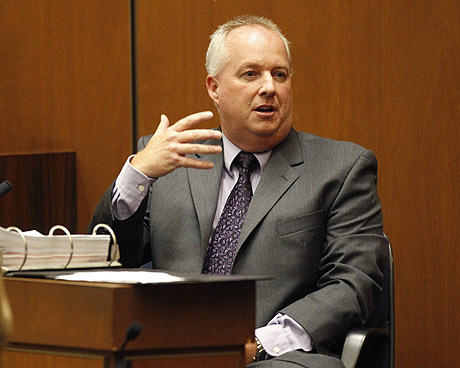
Dan Anderson, the toxicologist, said in the witness stand that in Michael’s body he found a combination of sedative drugs such as propofol, lidocaine, diazepam, lorazepam, midazolam, and ephedrine. He said that during the autopsy and toxicology, propofol was found in Michael Jackson’s blood, urine, and liver.
Anderson also said that there was no trace of narcotics or Demerol in his body. In their opening statements, the defense attorneys had claimed that Michael was addicted to Demerol.
Anderson continued that the amounts of three drugs—propofol, lidocaine, and lorazepam—in Michael’s body were significant. Murray had told emergency doctors that he had only given Michael lorazepam.
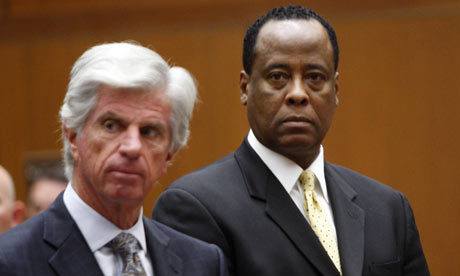
Murray’s defense attorney tried to find confirmation in Anderson’s testimony for his own theory that Michael caused his own death by ingesting lorazepam pills and propofol while Murray was out of the room. Michael Flanagan pointed out that the amount of lorazepam present in Michael’s stomach was more than the amount in his blood. But Anderson said those figures weren’t important and did not necessarily mean that lorazepam had been ingested.
Two days after Michael’s death, Murray told police that over 10 hours he had given Michael different sedative drugs.
The start of yesterday’s session was delayed because the judge had concerns about the medical records of Michael’s children that had been presented in court the day before. On Wednesday, prosecutor David Walgren presented Michael’s medical records in court, and his children’s records were shown along with them. The judge said he was concerned about the privacy of the deceased children in the case.
On Wednesday, the prosecutor displayed on a table in court all the pills and drugs that the medical examiner, Elissa Fleak, had collected from Michael’s room. The prosecution said these drugs were tools Murray used to treat Michael’s insomnia.
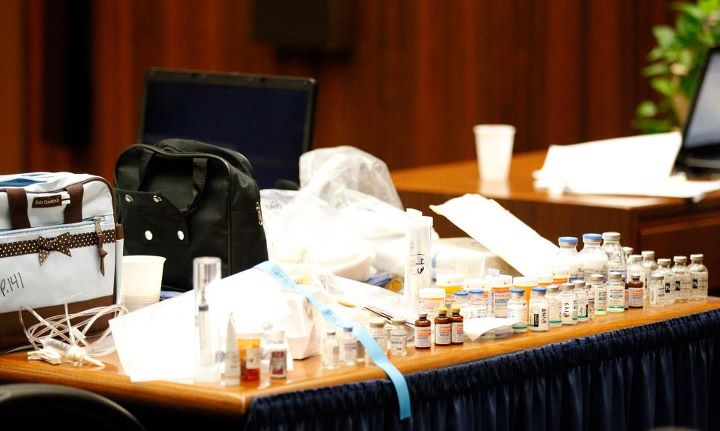
That day, Elissa Fleak testified that inside Michael’s room there was an IV bag placed on a stand that had been torn open, and inside it there was a propofol vial. The IV tube was connected to Michael’s leg, and the prosecution says this was a non-standard method Murray used as a drip injection of propofol into Michael.
On Thursday, during a question-and-answer session with Ed Chernoff, Murray’s defense attorney, Fleak agreed that until March of this year she had not said anything about the presence of a propofol vial inside the IV bag. Although this point had been recorded in her initial testimony in January.
Also, in her initial testimony in January, Elissa Fleak had said she found a detached syringe plunger on a table next to Michael’s bed, and she had also found the needle on the floor. But yesterday she said she was mistaken about the needle being related to that syringe, and she learned this earlier this year during a meeting with the prosecutor.
She also said that before a photo was taken of the syringe, she had moved its location, and her fingerprints were on the needle.
Fleak said she tore up the handwritten text of the report she prepared on the day Michael died, June 25, but she submitted the final version of the report that she wrote on June 29. She said this is her work habit—to destroy draft texts.
Ed Chernoff tried to present Fleak’s report as full of flaws and problems. He referred to photos showing that items had been moved during the inspection of Michael’s room, and said:
“Do you agree with me that in your inspections you made major mistakes?” Her answer was no.
The prosecutor stepped in to reduce the impact of the defense attorney’s actions:
“Ms. Fleak, was your inspection complete?” No.
“Has any inspection ever been complete in any case?” No.
Fleak said these inspections can never be complete, but she said she did her best to make her report as correct and truthful as possible.
On June 25, Fleak entered Michael’s room to examine the scene of death. Four days later, after Murray provided new information and said he had hidden drugs in a hidden cabinet, Fleak returned to that room.
She said returning to the crime scene wasn’t routine, but it was done because there was a lot of drug evidence in that room.
Source: eMJey.com / CNN