Day 14 of Court: Michael Jackson Did Not Inject Himself
Yesterday, professor Steven Shafer returned to the stand to deliver the most devastating testimony of this court period against the defendant, Murray.
Shafer, a specialist in administering propofol, told the jury that it’s impossible that Michael Jackson died because he ingested this drug, because propofol doesn’t enter the bloodstream that way.
He also said it was highly unlikely that Michael had managed to inject himself with a large amount of this drug. Shafer said it’s difficult to accept that Michael Jackson, during the short time Conrad Murray claims he was out of the room, got up from anesthesia and injected himself with a large amount of the drug.
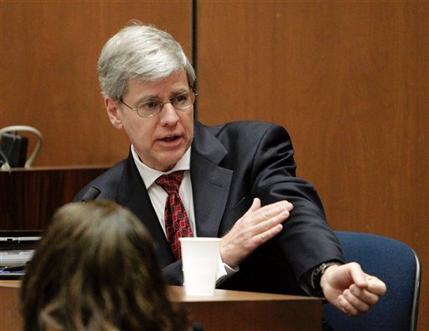
He said that getting up from anesthesia isn’t as simple as saying the word.
“This story they tell—that Michael woke up from anesthesia and injected himself—is crazy and insane. Getting up from anesthesia isn’t like that. It’s not like waking up from sleep. You wake up, take the syringe, and inject yourself... Such a thing is impossible.”
Shafer explained that injecting propofol without the help of a painkiller is extremely painful.
“Nobody wants to personally put something like that into their own vein.”
He also said that to inject propofol, you have to find a good vein in the body. Michael didn’t have such a vein, and it was difficult to find a suitable vein for injection.
Dr. Murray had chosen a vein near his knee for the propofol injection.
The doctor continued that it’s very likely that the amount of medication Conrad Murray gave Michael was much more than what he admitted to the police.
Another theory from Murray’s lawyers is that Michael caused his own death by taking 8 lorazepam pills when Murray wasn’t aware.
Shafer said that the investigations and tests carried out by Murray’s legal team show that in the 4 hours leading up to Michael’s death, Michael Jackson did not take lorazepam pills. Also, the amount found in his stomach was negligible.
In addition, the prosecutor announced that the medical examiner’s office had recently been contacted and said that the amount of lorazepam found in Michael Jackson’s stomach was even less than what the defense lawyers had stated in court and to the jury.
In the session before yesterday, Shafer reminded the jury that Murray had purchased more than 4 gallons of propofol for use on Michael. Shafer compared Murray’s behavior to that of an employee, not a doctor.
“Michael Jackson was saying, ‘I want this medicine, I want it, I want it!’ Well then, in this situation, Dr. Murray should have said you have insomnia and that a specialist should treat you. Dr. Murray acted like an employee of Michael Jackson and not like his doctor!”
Shafer also became visibly agitated in the witness box and his voice occasionally showed anger when he listed 17 major mistakes by Conrad Murray. He used words like “major, unethical, against conscience” to describe Murray’s actions, and said that all of these 17 mistakes each “directly” led to Michael Jackson’s death.
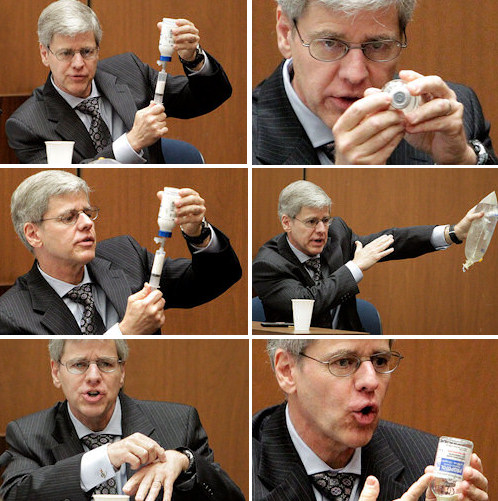
Professor Shafer, who considers propofol the achievement of his lifetime, feels this case is part of his own existence. It seems the case has another meaning for him, because no other witness has been as serious and diligent in the witness box as Shafer, and he has placed his time at the court’s disposal with self-sacrifice—even without receiving a fee. And this is happening while he has recently lost his father.
Shafer said he doesn’t believe Murray was only out of the room for 2 minutes. He added that it’s very believable that Murray left the room where Michael was unconscious for 45 minutes in order to make phone calls.
“In this situation, he couldn’t have realized Michael’s respiratory arrest. A lot of time passed. I think this is what truly happened.”
Another claim by Murray that Shafer challenged was that Murray had injected Michael with 50 milligrams of propofol for 80 nights. Murray also said that the last propofol injection was 25 milligrams.
Shafer explained that the evidence indicates Murray was injecting Michael with 100 milligrams of propofol every night.
On Wednesday, Shafer said that if Murray had stayed with Michael the whole time, noticed his respiratory arrest immediately, if medical equipment had been available, and if he had called emergency services right away, Michael Jackson would now be alive and healthy, with no damage or injury—because emergency responders would have arrived within 4 minutes.
Dr. Shafer said that after 8 minutes without oxygen reaching the brain, parts of it would be damaged, and if Michael had received help after that time, he would have lived but suffered brain damage.
Shafer emphasized:
“If the right equipment had been there and emergency services had been contacted on time, Michael Jackson would now be living without any harm or injury.”
On Wednesday, an educational video about the correct way to administer propofol in a hospital was shown in court, which you can watch here.
http://www.youtube.com/watch?v=eKVHw8jIByoSource: eMJey.com / washingtonpost / usatoday / AP