Day 13 of Court: Saving Michael Jackson Was Just a Matter of Lifting the Chin
Yesterday, after 5 days off, the court session resumed, during which professor Steven Shafer testified.
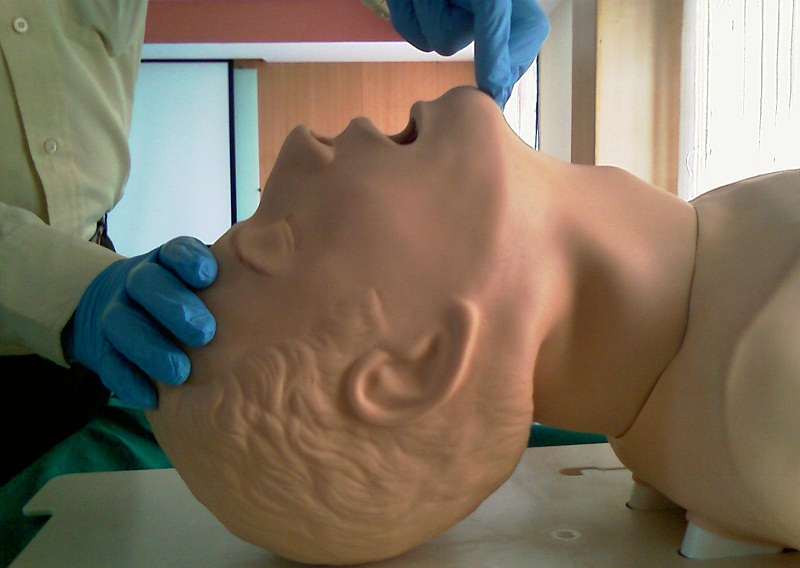
Shafer said Michael’s respiratory arrest was probably because his tongue had blocked the airway entrance to the trachea. He said Conrad Murray could have easily reopened his breathing path with a simple chin lift. Earlier, a heart specialist had testified in court that Michael’s death was due to blockage of the airway, and Shafer’s explanation confirmed that view. He said:
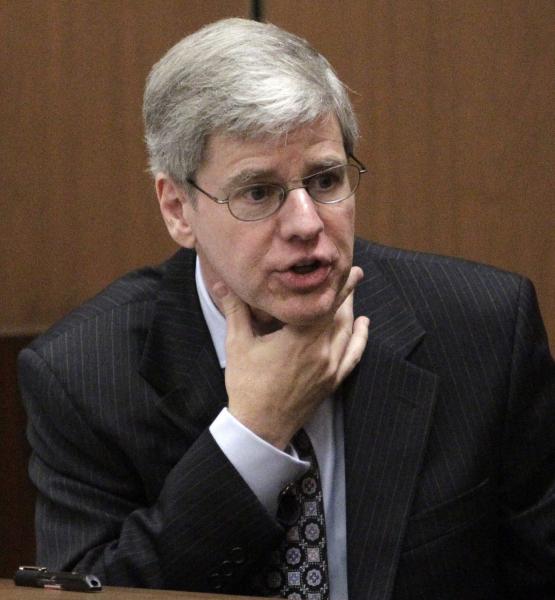
“Michael Jackson was trying to breathe, but he couldn’t because his tongue had fallen back to the end of his throat and blocked the airway entrance. Conrad Murray could have saved his life with just a simple chin lift alone, and/or by blowing air in a way that moved the tongue and reopened the airway.”
Shafer, who was likely the last witness for the prosecution, listed 17 major failings by Conrad Murray.
Murray’s use of propofol to put Michael to sleep at home for 2 months—every night, according to Shafer—was very strange and unusual.
He pointed out that the dangers of such a practice don’t even need to be mentioned, and that pharmacologists know this is a “never and under no circumstances” situation!
Shafer said that no environmental safeguards were carried out for injecting propofol in Michael Jackson’s room.
One of Murray’s major failings was an ineffective heart-rate monitor that didn’t have an alarm to alert Murray in case Michael had a respiratory arrest.
Shafer said: “If such a device had been there, maybe Michael Jackson would have lived.”
“When Michael Jackson requested propofol, Murray should have said no to him like a doctor would. But he didn’t act like a doctor.”
“Murray should have said you have an insomnia problem and that a specialist doctor should see you. I can’t put you to sleep with your propofol.”
Shafer said that even for a single second, an unconscious person should not be left alone, because a disaster could happen.
Conrad Murray left Michael alone to go to the bathroom and to make phone calls to his coworkers and girlfriends. He himself said he left Michael for only 2 minutes. But based on evidence obtained from his phone, it’s clear that the time he left the patient was much longer than that. In his police interrogation, he didn’t mention his phone calls that kept him busy for nearly 45 minutes.
Shafer said leaving his patient to go to the bathroom was like a driver letting his engine run while going down a steep hill, and then abandoning it to go to the bathroom.
He said that respiratory arrest for a doctor who knows his job is not a complicated or difficult situation.
“If he had lifted Michael Jackson’s chin a little, or if he had caused the tongue to move by blowing air and reopened the airway, he would have lived.”
“But when Murray returned from the bathroom and saw that his patient wasn’t breathing, he was confused and lost his footing.”
From the time Murray claims he noticed Michael Jackson’s respiratory arrest until the time he called emergency services, there is a 20-minute gap.
Shafer said that even without medical equipment, if Murray had alerted emergency personnel sooner, Michael Jackson would have lived. Of course, Shafer said that because oxygen hadn’t reached the brain for a long time, Michael would likely have suffered brain damage even if he had survived.
In this session, a video was shown in court that taught the correct way to administer propofol in a hospital. In the video, an actor pretended to have a heart attack during anesthesia, and it showed how doctors and nurses revive this hypothetical patient using drugs, equipment, and facilities that Dr. Murray did not have at the moment of Michael Jackson’s death.
In the video, doctors check every single piece of equipment before starting the injection. The exact amount of propofol is also determined by a mechanical pump.
Shafer explains:
“These steps are applied to each patient. There are no exceptions.”
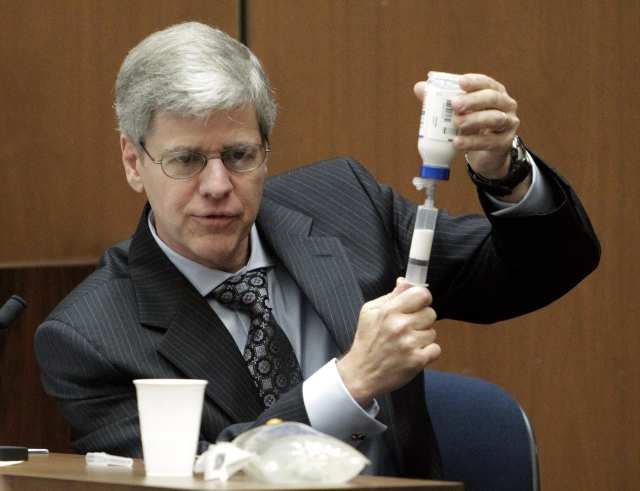
Throughout the video, at Shafer’s request, his assistant would stop the playback so he could provide the necessary explanations. Shafer said how Murray’s actions deviated from the standard shown in this video.
The medical world is indebted to Shafer for his services in recognizing and using propofol better. The prosecutor uses Shafer’s testimony to make Conrad Murray’s major mistakes look even worse.
When the patient in the video has a heart attack, the phrase “Help me!” appears at the top of the monitor screen.
Shafer, who has whitened his hair with propofol powder, tells the jury:
“The first thing you do in this situation is ask for help. That’s the first thing they teach an anesthesiology doctor on the first day they enter university!”
Delays in contacting emergency services are one of several reasons the prosecutor cites to call Murray guilty.
Conrad Murray’s phone shows that he hadn’t realized the seriousness of Michael’s condition because he was busy with his phone calls. But even after he finally went to his patient and realized he wasn’t breathing, he still delayed calling emergency services for 20 minutes.
The video also demonstrates the correct method of artificial respiration—something Conrad Murray didn’t know.
In the video, the doctor gives artificial respiration to the patient with both hands, and this must continue without stopping until the person breathes or dies. Michael’s employee, Alberto Alvarez, had previously testified in court that Conrad Murray gave Michael artificial respiration intermittently and with only one hand.
Before the video was shown, Murray’s defense attorney, Ed Chernoff, tried to prevent its playback by claiming the jury would be influenced. But prosecutor Walgren said the only purpose of the video was to teach the correct way to administer anesthesia with propofol.
The judge determined that parts of the video should be edited, but allowed most of it to be shown in court. Walgren used his recess time to remove parts of the film, including a scene where the hypothetical patient has an airway obstruction. The judge’s justification was that Michael Jackson’s death due to airway obstruction was not mentioned in the prosecutor’s complaint. However, the scene where the hypothetical patient has a cardiac arrest was shown in court.
Shafer, one of the veterans and best-known figures in the world of medical anesthesia, said he wasn’t paid for his testimony because he doesn’t want people to think his statements are influenced by the money he received.
He said he testifies because he feels the Michael Jackson murder case—and how controversial it is—has dealt a blow to the medical community and tarnished the good name of doctors.
“I felt it was necessary to step forward to restore trust in the community. Help people understand that doctors put their patients first above everything else.”
“People should know that Conrad Murray’s way of administering anesthesia is not the way we specialized doctors do it. I want to teach you the right method so you won’t be afraid of our work anymore.”
“This case has given propofol a bad reputation.”
“I hear this every day... ‘Do you want to give me propofol? The same drug that killed Michael Jackson?’... This fear shouldn’t remain in the heart of the community.”
Source: eMJey.com / CNN / LA Times