Michael and vitiligo
After Michael’s death, his dermatologist, Dr. Arnold Klein, confirmed on CNN’s Larry King Live that Michael Jackson had suffered from the skin condition vitiligo, which destroys skin pigments. Dr. Klein appeared on the show to refute rumors that Michael did not want to be Black. He said he was shocked by what Quincy Jones, the producer of Thriller, had said—that Michael definitely did not want to be Black.
Dr. Klein said that Michael’s skin became lighter and lighter over the course of his life due to vitiligo. He emphasized that Michael was proud of his race and African heritage. In vitiligo, skin pigments are lost, leaving white patches on the skin. In reality, the colorless skin becomes highly vulnerable to the sun. Below are images showing signs of this condition on Michael’s hands. The second photo was taken of Michael’s injured foot, which resulted from being bitten by a poisonous spider in 2002; around the wound, signs of vitiligo are visible.
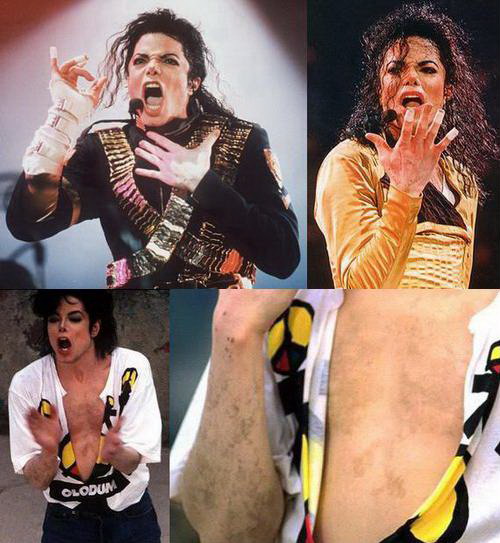
Dr. Klein said he had tried in vain to slow the progression of Michael’s condition:
“There is a solution in which, by using ultraviolet radiation on the white spots on the skin, they become darker.”
But Michael’s condition was particularly bad, because:
“He had white spots all over his body... across the entire surface of his body, as well as on his hands and face, where treatment was difficult. His vitiligo became so severe that it was simpler to use special whitening creams to make the remaining dark areas lighter and even out his skin tone. The result for Michael was a uniform—though pale—skin.”
“That was a decision we were ultimately forced to accept. Otherwise, he would have had to use extremely heavy makeup on his face during stage performances, which would have looked ridiculous and had to be shown to the public with that very strange appearance.”
Michael’s white sequined glove is now a symbol. But according to actress Saisley Tyson, at first it was a tactic used to cover the spots on Michael Jackson’s hands. In the 1980s, this actress had the same dress designer working for her who was making gloves for Michael. Saisley says that this designer told her that he was sewing gloves for Michael. Michael was in the early stages of his illness, and vitiligo had appeared on the back of his hand.
Michael first revealed, with distress, that his skin was losing color due to vitiligo in an interview with Oprah Winfrey in 1993. According to what Michael said in that interview, the early signs of his condition should have appeared between 1979 and 1982.
Michael said that to even out his skin tone, he had to use makeup. When he was asked why he didn’t use brown makeup on his skin and instead used lightening creams, he answered that more of his skin had already turned white, so showing the lighter parts was easier than coloring the white spots.
Michael’s makeup artist, Karen Faye, said: “He was trying to hide this condition even from me. He was trying to even out his skin tone with makeup until the disease spread and reached his entire body. We were always trying to cover the spots until finally he was forced to tell the truth to Oprah and the world: ‘See, I’m not trying to be white. I have a skin problem.’”
“At first, I tried to cover the white spots on his skin so they would match the darker color of the rest of his body. But then the white spots spread all over his body so much that we had to match his skin tone to the white areas. He had to apply makeup to his entire body. Every inch of his skin. So it was simpler to match the dark areas to the white parts of his body.”
From the beginning of his skin lightening until now, Michael has been accused of racism, and it has always been said that he didn’t want to be Black. Some said Michael tried to change his race because of the problems he had with his father and the hatred he felt toward him due to the abuse—at times he felt he didn’t want to be like his father. Others said he wanted to deny his race in order to gain a larger audience in the music world. But in response to such claims, Michael said in his 1993 interview:
“I’m Black, and I’m proud of it. I’m proud of the person I am. I have many achievements and a lot of self-esteem.”
He also said, “Why does this matter so much? It doesn’t matter to me. I love art. I love Michelangelo. If I had the chance to meet him, I would ask him what inspires him—not what he did last night.”
In 2005, a Fox Entertainment reporter named Lee Thomas revealed that he had the same condition. He published unretouched photos showing his condition clearly without makeup. He said he used colored creams to cover these spots.
Thomas, 40 years old, who had kept this secret only to himself and his family members since he was 25, told the public that year: “I’m a Black person who is turning white.”
Sixty-five million people worldwide (about 1% of the world’s population) and two million people in the United States have this condition. But before Michael Jackson first spoke about it in the early 1990s, very few ordinary people had heard of it.
Robert Haz, head of the Vitiligo Foundation, says the disease targets the spirit and self-confidence of the person affected. Vitiligo has no specific cause or definitive cure, and can only be managed. This condition does not cause physical pain, but it can leave serious emotional effects on the person. Feeling mocked by others and people’s looks can damage their self-confidence. These people may be shunned by society because many people, seeing their skin, feel uncomfortable and sometimes imagine vitiligo as contagious and dangerous—like leprosy—and for that reason they push these patients away. Haz continues: “Do you remember the last time a person with vitiligo brought you food in a restaurant?”
Professor Sancy Likman from the Department of Dermatology at the University of Utah in the United States also says that some people with this condition commit suicide. They constantly think that everyone’s eyes are on them, develop obsessive thoughts about themselves, and their self-confidence is severely damaged.
Thomas also used makeup and cosmetics for this reason. But after his two-colored hands frightened a preschool girl and made her cry, he realized he couldn’t hide it anymore. He thought his career was at the end of the line, and when he told the news department manager the reason for his resignation, Danna Haan encouraged him to stay and share his story with the public. Thomas finally agreed and revealed his secret in November 2005. After that, letters and emails of public support poured in through the news network. But although some people understand, others prefer to deal with the affected person differently. Thomas’s 28-year-old girlfriend said that in those years, when they went out together, people’s attention was on Thomas and some people behaved rudely toward him. Still, Thomas says that letting go of makeup and getting rid of worries about his appearance made him more aware of his inner values.
Source: eMJey / CNN / USA Today