Corey Feldman Dances for Michael Jackson in Moonwalk
Corey Scott Feldman (Corey Scott Feldman), born July 1971, is an American film and television actor. He was friends with Michael Jackson for 18 years starting from his teenage years, and then their relationship ended. According to him, when Michael died, it was eight years since the end of their friendship.
Corey and Michael first met in 1984, when they were introduced as friends. That year, Feldman—at age 13—had become famous with the comedy-horror film Gremlins.
2010/10/24
Michael never said anything about his relationship with Corey Feldman, but some say it ended in 2001 after the terrorist attacks on the World Trade Center towers in New York, when Michael left the city without Feldman.
Michael took the stage for two concerts on September 7 and 10, 2001 to celebrate the 30th anniversary of his solo career in Madison Square Garden in New York. After the September 11 attacks, the Jackson family traveled home by bus, but Michael traveled with his children to the home of the Cassio family in Franklin Lakes, New Jersey. They stayed there for two weeks, and then flew to Burbank in Los Angeles County on a private plane.
Some say that even though Corey Feldman was a 30-year-old man, he was upset that Michael didn’t take him with him. Michael was a father and had to take care of his children.
After the 2003 accusations against Michael, Corey Feldman—who had supported Michael faithfully in 1993—felt the situation was appropriate to take revenge for that separation. He questioned his 18-year friendship with Michael and said he had faced some troubling, questionable points.
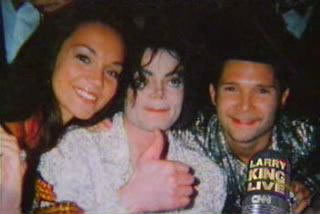
In a television interview, he mentioned an incident from years earlier, when he was a teenager and noticed a medical book on Michael’s table. That medical book contained pictures of nude bodies of people who had contracted sexually transmitted diseases. When Corey noticed the book, Michael decided to show him the pictures and explain the diseases to him.
This statement by Feldman, while Michael was under a microscope and facing intense media attacks, received widespread coverage and sparked a new wave of threats against Michael. Feldman’s story was altered by the media and news agencies, and it was retold in a way that said Michael Jackson had shown a teenager a pornographic book containing nude pictures of women and men.
After that, Corey Feldman’s name was added as a sexual victim in the case of accusations against Michael, and he was asked to testify in court in 2005 against Michael.
Thomas Mesereau, Michael’s defense attorney, called three of the five boys the prosecutors claimed were Michael’s victims to the stand, and they defended Michael. The fourth was the same complainant from 1993, who again did not show up to testify against Michael. The fifth was someone who had demanded money in exchange for his claim.
But later, Corey Feldman again made a sudden turn in his statements, saying that the only fault of Michael Jackson was that he left the teenage boys who were attached to him and dependent on him—leaving them behind.
Feldman’s statements are contradictory and strange, and his fans have accused him of hypocrisy. He said that by leaving him, Michael broke his heart and ruined his life:
“For a deadly teenager, it’s terrible to talk to Michael today, and then when you call him the next day, you find out that Michael’s phone number has changed.”
Their friendship lasted 18 years, and we all know teenage years don’t last 18 years—so it’s impossible that Michael left him behind during his teenage years.
After 2001, Feldman cut off his relationship with Michael, and later said he wasn’t answering his calls. Michael died at his home on June 25, 2009.
The day after Michael’s death, Corey Feldman appeared on Larry King Live, broadcast on CNN in the U.S., wearing the sunglasses and black hat that Michael had given him as a gift, with an embarrassed look. He expressed his sorrow over Michael’s passing. He said he didn’t want to talk about the past and the controversial debates of that time, and stated that for years he hadn’t spoken with Michael, but recently he had spoken with his family.
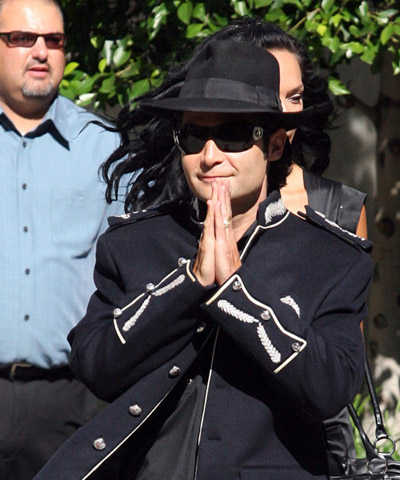
Feldman was also one of the guests at Michael’s memorial service on July 7 at the Staples Center. He attended the ceremony wearing an outfit similar to Michael’s during the Dangerous album era. Feldman then said the ceremony was emotional and beautiful, and he hoped Michael’s memory would live on for changing and improving the world.
He said Michael had changed the lives of many children and helped them progress. By forming friendships with them, he became their teacher and mentor, helping them overcome their problems and find the path to victory and success.
“I was a 12-year-old child whose family didn’t want me, and my classmates also ran away from me. Michael would sit with me for hours and talk to me, and he listened to what I said.”
He dedicated a concert in Los Angeles to Michael and told the crowd that Michael was watching their performance. After the concert ended, he told People magazine:
“I didn’t think I’d be able to get on stage tonight. Right now, I feel very helpless. Michael’s death shocked me. I’m still in shock, and I don’t think I’ve accepted the reality yet. Things are going through my mind, and for a moment a spark goes off, and I ask myself: did he really go? It bothers me.”
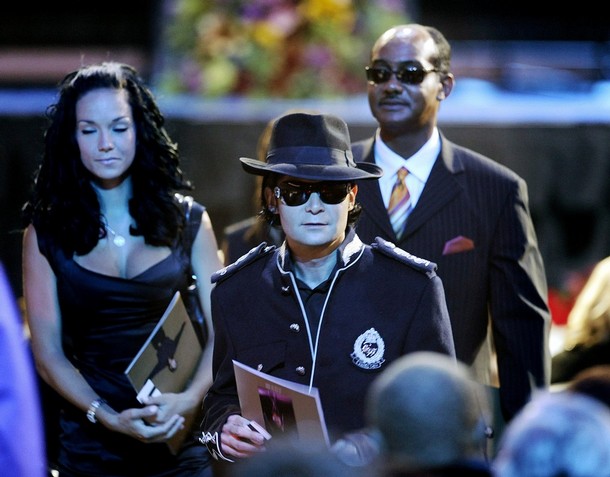
It was Feldman’s conscience that was hurting him. A year later, at Michael’s memorial celebration, he apologized to him and said he regretted why, over all those years, when Michael called him to comfort him, he didn’t answer his phone calls.
“I’ll never be able to escape the truth that I lost the chance to say goodbye to him, to hug him, and to tell him how much I love him. So I want to use this opportunity right now and say: Michael, I forgive you. I hope you forgive me too. I love you.”
He said that when he was young and got caught in addiction, Michael—through his help and companionship—helped him overcome his addiction.
We know why he asked Michael for forgiveness, but the fact that he says he also forgave Michael may mean that he is no longer upset about why Michael, in 2001, didn’t hold him like a 30-year-old child in his arms to take him away from New York, which was a victim of rubble and fire.
Feldman had previously announced that he intended to sell the glasses Michael had given him as a gift.
On June 25, 2010, during an auction of Michael memorabilia by Julien’s Auctions, a pair of sunglasses with a golden metal frame—Michael had given them to Corey Feldman—sold for $60,000. Michael had worn these sunglasses on stage during the Victory Tour in 1984. In the letter attached to the glasses as a certificate of authenticity, Feldman was quoted as saying that Michael had given him these sunglasses in 1985.
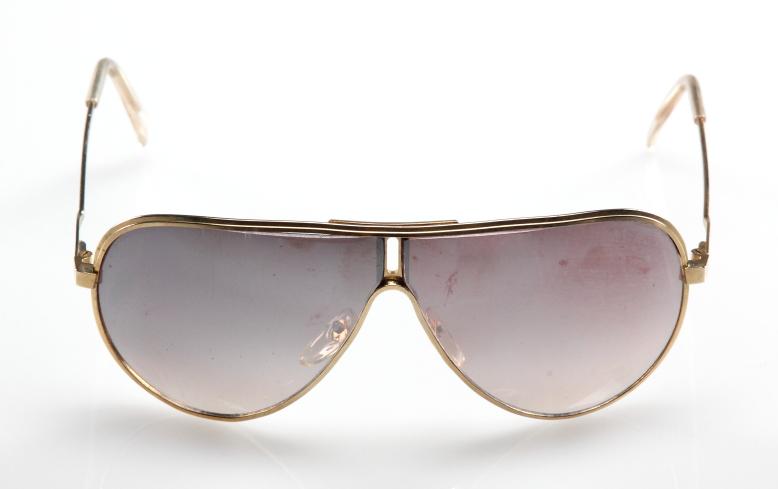
According to Timothy Stinson, manager of the Victory and Bad Tours, the sunglasses Michael used during the Victory Tour were collected by him and then given to the winners of newspaper competitions when they traveled to big cities. After the concert ended, he would stand there to hand over Michael’s sunglasses. Every week, he would take the collected sunglasses to Michael for signing. The glasses were engraved with phrases like MJ 33-01.
Michael would take some of the sunglasses to give to friends. He told Stinson that he would give Corey Feldman some unsiged sunglasses to use, and he would also give him some signed sunglasses to keep as souvenirs. The sunglasses Feldman sold were one of the unsiged souvenirs.
Two years have passed, and now Corey Feldman has another idea in his head. He says he wants to dance on ice in honor of Michael. He is one of the participants in the ice-skating dance competition Dancing on Ice, broadcast on ITV1. Feldman says:
“I secretly practice Moonwalk on ice. I don’t know if I’ll be allowed to do it. A lot of it depends on whether we can get permission to play Michael’s music. The fact that I’m friends with the Jackson family might be helpful in this matter and help me. I want to dance on ice to Billie Jean.”
Source: eMJey / People / Daily Star