AEG Court: A Clash of Top Legal Firms

The AEG courtroom was the stage for the face-off and rivalry between two lawyers from two top legal firms. Brian Panish, who defended the Jacksons, and Marvin Putnam, who represented AEG, repeatedly turned the courtroom atmosphere into a tense spectacle. At times, members of the jury would laugh at the bickering between the two; at other times, the judge warned them that he would reprimand them.
One of the last battles between the two attorneys happened when Putnam claimed that Panish had shown him his middle finger—an act with a very offensive meaning in American culture. Panish: "If I want to show him a finger, I know how to show it." Putnam: "And you did it twice very well." Panish: "No, I haven’t done it, but if he wants me to show him his finger, I’ll be happy to do it."
The two lawyers glared at each other in court, shouted over one another, and even fell out.
Once, in the courthouse hallway while speaking with the media, their argument escalated so much that the court clerk had to step in. The next morning, the judge told them that if they didn’t correct their behavior, he would dismiss them.
Their dispute always drew eager, excited looks from the jury members. Perhaps in their calm, everyday lives, they’re deprived of watching such highly charged scenes.
At one point, Putnam called Panish "a lowlife" and refused to make peace with him.
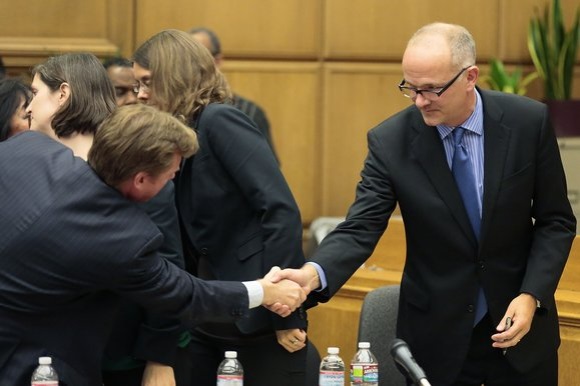
Putnam: "Where I come from, a handshake means something."
Panish: "I don’t recall a case where this much hatred and hostility was going on. When I say good morning to them, they don’t even answer."
Defense of AEG was handled by the 128-year-old law firm O'Melveny & Myers. Eight hundred lawyers work for them across sixteen offices around the world. They’ve represented well-known clients—from Warner Brothers to White House advisers.
Facing them was Panish, Shea and Boyle, a firm with one office and fifteen lawyers. They led the Jacksons’ case. Of course, Panish was a veteran of the profession with more than a hundred cases. Twenty of the cases his firm had won were worth more than $10 million. They also won a $9 billion case against General Motors—the largest personal injury damages case against a company in history—though the judge later reduced the amount to $1 billion. The firm’s income was so high that it held a stake in two airplanes.
Both Putnam and Panish are among the top 100 attorneys in the state of California, but they have the smallest possible similarity. That similarity isn’t even seen between their firms and their colleagues. The defense lawyers’ clothing was consistently black and dark gray. Every day during those five months, Jessica Benna spent them in a single outfit: a dark suit. On the other side was Deborah Chung, the Jacksons’ lawyer, asking questions of witnesses with dangling earrings, high heels, and a light green blazer.

The company’s lawyers were led by Putnam, while the Jacksons’ lawyers were led by Panish. Putnam is middle-aged, well-groomed, and on the verge of going bald. He’s a Harvard graduate. His wife was also a Harvard student and is the director of the Robert Redford Institute, the American actor and director.
Panish is a showman. He’s a heavyweight lawyer with a deep voice. He studied at Catholic schools. Thomas Mesereau had suggested him to the Jacksons. In 2005, Mesereau cleared Michael of the charges, and since then he’s become a hero and a figure respected by fans. Mesereau had told the Jacksons that Panish was the best option for legal cases in Los Angeles, and that no one could come close to him.

Even the way the two firms make money is different. The lawyers in this firm get paid by the hour whether they win or lose a case. Before the verdict was announced, they had already earned several million dollars from AEG for the work they presented in court. Their pay is calculated hourly. But Panish’s and his team’s fees depended on winning the case. For Panish’s firm, each case is an investment—so that’s why they’re extremely cautious when choosing cases and accept fewer than one percent of them for pursuit. That means Brian Panish had high confidence in winning the Jacksons’ case, but in the end his calculations turned out wrong. The firm takes up to 40% of the damages paid to the plaintiff as its fee, and if they lose, they’re hit hard—not only do they not get paid, they also have to cover court costs.
A professor at the USC law school says: "You have to be willing to take risks to become a lawyer."
Whether they won or lost the AEG case, Putnam and his assistants still got paid. Panish had pointed out that the winner would likely be his own firm:
"The lawyers at that big firm get paid by the hour. We’ll probably get it too."
While lawyers like Marvin Putnam appear less often in court, this is a second home for attorneys who handle damages cases like Brian Panish. Kevin Boyle, Panish’s assistant, said that the number of cases Panish has taken to court in the past three years is greater than the total number of cases Putnam’s team has defended in court over their entire lives. From this comparison, you can see how tough Putnam’s team had it in court. Panish was a formidable opponent for Putnam, especially because he had powerful closing arguments. Now Putnam can finally breathe easier.

It’s true that with AEG’s acquittal, the company won’t pay damages to the Jacksons, but let’s not forget that Brian Panish proved in court what many people didn’t believe—and he got the jury’s verdict. Conrad Murray had been hired by AEG! And that means Panish drove his point home against Putnam.
In recent weeks, the AEG case had been idle—jury members fled the courtroom under various pretexts. But Panish wouldn’t sit idle. Recently, while the AEG court was taking a week off, he won a $17 million case. The plaintiff was an 85-year-old man who had been left with an amputation as a result of a bus accident.
During the trial, Marvin Putnam leveled many accusations against Panish, accusing him of slander and lying. Kevin Boyle said Putnam had gone beyond his bounds and lacked manners. One of the most ridiculous incidents happened when Putnam and his assistants refused to accept the fact that Michael had passed away even after the trial began. Boyle was the plaintiff who believed Putnam considered himself superior to them and was very self-satisfied.

Putnam accused Panish of leaking AEG emails to the media. Panish was furious at this accusation:
"I’m not happy that they’re questioning our integrity."
Panish had said that before the Jacksons’ case, he had fought against Putnam’s company as well, and he had no problem with their lawyers.
"I don’t have a problem with this law firm. It’s Putnam who doesn’t like us. There’s nothing we can do about it. Not everyone in the world is going to love me."
Beyond the arguments between the two lawyers and the side-eyeing of their assistants, this trial also saw other serious problems—ones caused by high-profile plaintiffs.

Once, the sound of a camera flash echoed through the courtroom. Someone was arrested. That person was William Wagner, the man who last year filed a complaint against prosecutor Thomas Sneddon—who had brought Michael to court on the false charge of sexually abusing children—to the judicial system, though no result was expected. In any case, Wagner was arrested in court for photographing members of the jury, and his camera phone was confiscated. He claimed that his hand had accidentally hit the photo option.
Images of jury members were not supposed to be published to protect them and their verdict.
Once again, a woman tried to attack the women on the jury and deliver a message to them: "You shouldn’t let any money go to the Jacksons!" The woman was arrested and reprimanded. Communication with jury members was absolutely not allowed, and the judge dealt with the issue harshly.
This trial saw many tears—and sometimes even laughter. During the trial, jury members heard details of Michael’s private life, got to know his family and children, and listened to the words of his mother and son. They watched videos, songs, and the film Dis is It, and met many celebrities, including Connie Ortega, who escorted her after the end of her testimony with her cheers. If the jury members didn’t know anything about the King of Pop before, now they’re returning home with a bag full of Michael-related knowledge.
Source: eMJey.com & LA Times