Michael Jackson and Judaism against Hitler and Nazism
Over the past few days, the rumor that Michael supports the Nazi Party has spread from site to site across the internet. The story began when Matt Fiddes, Michael’s former bodyguard, on Tuesday, in an interview with The Sun, called Michael a Nazi alongside other claims.
Rabbi Shmuley Boteach, a well-known Jewish speaker and rabbi who formed a friendship with Michael Jackson in the late 1990s, has come out in support of him against claims of antisemitism and support for Hitler.
The rabbi called the lie nauseating and said: "I was Michael’s spiritual teacher for two years. During these two years we talked about everything. Michael looked down on anyone who oppressed or harmed someone else and expressed his hatred. He was disgusted by Hitler and everything he did. Michael was a good friend of the Jewish people."
In an article published in The Huffington Post, he wrote: The good name is the only thing that remains from a person; may a good name remain, like the wise man’s house. So it is our right to defend our name against destruction and insults. When someone’s name is attacked and he is not here to defend himself, it is our duty to protect his name.
Heaps of empty, baseless things have been said and written about Michael Jackson, and to my great sadness, he is no longer among us. I don’t want to draw a bold line under them by responding to their nonsense. But seeing the big headlines written in the voice of Michael’s former guard about his support for the Nazi Party caught my attention. Usually, one shouldn’t say anything in response to such evil because it makes it more prominent, but the accusation made against Michael here is so huge that it cannot be ignored.
 I was Michael’s spiritual teacher for two years. During these two years we talked about everything. Our conversations were recorded on audio tapes, and I published them in books titled "The Michael Jackson Tapes" (2009) and "Honoring the Child Spirit" (2001).
In one of our discussions, Michael talked about Hitler’s hypnotic speeches and his skill in doing so. He said that oratory is one of the most effective tools of the devil for taking control of people and sitting on the throne of power. He said Hitler used the same tool that many showmen today use to mislead their audiences and guide them toward evil paths.
When the book was published and I saw how the media portrayed Michael’s words differently—writing that he admired Hitler—I felt despair and disappointment. No bigger lie could have been told.
Michael looked down on anyone who oppressed or harmed someone else and expressed his hatred. Especially the Nazi Party, which massacred 6 million Jews, 1.5 million of whom were children. He was disgusted by Hitler and everything he did. As I have always said, Michael was a good friend of the Jewish people. He was never ashamed to say how much he had learned about Judaism during our discussions.
In one of our first meetings, I gave him a mezuzah—something with a text from the Torah engraved on it—that would be hung on the door. My intention was not to ask him to hang that mezuzah on his home door like Jewish people do. But he insisted that it be placed on the main door of his rented home in Manhattan. A few weeks later, he came with me to the synagogue in Manhattan, to Karelbach Synagogue, for one of the happiest Jewish religious celebrations (Shmini Atzeret). Then he told me that he had spent one of the happiest nights of his life.
When Michael was touring as a child with the Jackson Five, a Jewish teacher named Rose Fine traveled with him city by city and taught him. Michael spoke about her with great respect and revealed to me that when Fine had reached adulthood, she and his sister Janet covered his living expenses. Michael told me that once, when their plane had landed in Germany, Mrs. Fine became anxious and frightened. Michael asked what the reason was, and Fine shared with him the memory of the terror of the Jewish massacres (during World War II in Europe). He was still a boy and was hearing about it for the first time.
I took Michael to meet my dear friend Elie Wiesel*—the Nobel Peace Prize winner—who is the greatest living Jewish figure. Professor Wiesel welcomed Michael warmly and kindly, and spoke with him about the horror of the massacres and the need for reconciliation and love.
In 1993, Michael traveled to Israel for his dangerous tour and performed in Tel Aviv in front of 160,000 fans on stage. My dear friend Frank Cascio, who later became Michael’s tour manager, accompanied him on this trip and told me how happy Michael was to be in the Holy Land.
I was Michael’s spiritual teacher for two years. During these two years we talked about everything. Our conversations were recorded on audio tapes, and I published them in books titled "The Michael Jackson Tapes" (2009) and "Honoring the Child Spirit" (2001).
In one of our discussions, Michael talked about Hitler’s hypnotic speeches and his skill in doing so. He said that oratory is one of the most effective tools of the devil for taking control of people and sitting on the throne of power. He said Hitler used the same tool that many showmen today use to mislead their audiences and guide them toward evil paths.
When the book was published and I saw how the media portrayed Michael’s words differently—writing that he admired Hitler—I felt despair and disappointment. No bigger lie could have been told.
Michael looked down on anyone who oppressed or harmed someone else and expressed his hatred. Especially the Nazi Party, which massacred 6 million Jews, 1.5 million of whom were children. He was disgusted by Hitler and everything he did. As I have always said, Michael was a good friend of the Jewish people. He was never ashamed to say how much he had learned about Judaism during our discussions.
In one of our first meetings, I gave him a mezuzah—something with a text from the Torah engraved on it—that would be hung on the door. My intention was not to ask him to hang that mezuzah on his home door like Jewish people do. But he insisted that it be placed on the main door of his rented home in Manhattan. A few weeks later, he came with me to the synagogue in Manhattan, to Karelbach Synagogue, for one of the happiest Jewish religious celebrations (Shmini Atzeret). Then he told me that he had spent one of the happiest nights of his life.
When Michael was touring as a child with the Jackson Five, a Jewish teacher named Rose Fine traveled with him city by city and taught him. Michael spoke about her with great respect and revealed to me that when Fine had reached adulthood, she and his sister Janet covered his living expenses. Michael told me that once, when their plane had landed in Germany, Mrs. Fine became anxious and frightened. Michael asked what the reason was, and Fine shared with him the memory of the terror of the Jewish massacres (during World War II in Europe). He was still a boy and was hearing about it for the first time.
I took Michael to meet my dear friend Elie Wiesel*—the Nobel Peace Prize winner—who is the greatest living Jewish figure. Professor Wiesel welcomed Michael warmly and kindly, and spoke with him about the horror of the massacres and the need for reconciliation and love.
In 1993, Michael traveled to Israel for his dangerous tour and performed in Tel Aviv in front of 160,000 fans on stage. My dear friend Frank Cascio, who later became Michael’s tour manager, accompanied him on this trip and told me how happy Michael was to be in the Holy Land.

 I was Michael’s spiritual teacher for two years. During these two years we talked about everything. Our conversations were recorded on audio tapes, and I published them in books titled "The Michael Jackson Tapes" (2009) and "Honoring the Child Spirit" (2001).
In one of our discussions, Michael talked about Hitler’s hypnotic speeches and his skill in doing so. He said that oratory is one of the most effective tools of the devil for taking control of people and sitting on the throne of power. He said Hitler used the same tool that many showmen today use to mislead their audiences and guide them toward evil paths.
When the book was published and I saw how the media portrayed Michael’s words differently—writing that he admired Hitler—I felt despair and disappointment. No bigger lie could have been told.
Michael looked down on anyone who oppressed or harmed someone else and expressed his hatred. Especially the Nazi Party, which massacred 6 million Jews, 1.5 million of whom were children. He was disgusted by Hitler and everything he did. As I have always said, Michael was a good friend of the Jewish people. He was never ashamed to say how much he had learned about Judaism during our discussions.
In one of our first meetings, I gave him a mezuzah—something with a text from the Torah engraved on it—that would be hung on the door. My intention was not to ask him to hang that mezuzah on his home door like Jewish people do. But he insisted that it be placed on the main door of his rented home in Manhattan. A few weeks later, he came with me to the synagogue in Manhattan, to Karelbach Synagogue, for one of the happiest Jewish religious celebrations (Shmini Atzeret). Then he told me that he had spent one of the happiest nights of his life.
When Michael was touring as a child with the Jackson Five, a Jewish teacher named Rose Fine traveled with him city by city and taught him. Michael spoke about her with great respect and revealed to me that when Fine had reached adulthood, she and his sister Janet covered his living expenses. Michael told me that once, when their plane had landed in Germany, Mrs. Fine became anxious and frightened. Michael asked what the reason was, and Fine shared with him the memory of the terror of the Jewish massacres (during World War II in Europe). He was still a boy and was hearing about it for the first time.
I took Michael to meet my dear friend Elie Wiesel*—the Nobel Peace Prize winner—who is the greatest living Jewish figure. Professor Wiesel welcomed Michael warmly and kindly, and spoke with him about the horror of the massacres and the need for reconciliation and love.
In 1993, Michael traveled to Israel for his dangerous tour and performed in Tel Aviv in front of 160,000 fans on stage. My dear friend Frank Cascio, who later became Michael’s tour manager, accompanied him on this trip and told me how happy Michael was to be in the Holy Land.
I was Michael’s spiritual teacher for two years. During these two years we talked about everything. Our conversations were recorded on audio tapes, and I published them in books titled "The Michael Jackson Tapes" (2009) and "Honoring the Child Spirit" (2001).
In one of our discussions, Michael talked about Hitler’s hypnotic speeches and his skill in doing so. He said that oratory is one of the most effective tools of the devil for taking control of people and sitting on the throne of power. He said Hitler used the same tool that many showmen today use to mislead their audiences and guide them toward evil paths.
When the book was published and I saw how the media portrayed Michael’s words differently—writing that he admired Hitler—I felt despair and disappointment. No bigger lie could have been told.
Michael looked down on anyone who oppressed or harmed someone else and expressed his hatred. Especially the Nazi Party, which massacred 6 million Jews, 1.5 million of whom were children. He was disgusted by Hitler and everything he did. As I have always said, Michael was a good friend of the Jewish people. He was never ashamed to say how much he had learned about Judaism during our discussions.
In one of our first meetings, I gave him a mezuzah—something with a text from the Torah engraved on it—that would be hung on the door. My intention was not to ask him to hang that mezuzah on his home door like Jewish people do. But he insisted that it be placed on the main door of his rented home in Manhattan. A few weeks later, he came with me to the synagogue in Manhattan, to Karelbach Synagogue, for one of the happiest Jewish religious celebrations (Shmini Atzeret). Then he told me that he had spent one of the happiest nights of his life.
When Michael was touring as a child with the Jackson Five, a Jewish teacher named Rose Fine traveled with him city by city and taught him. Michael spoke about her with great respect and revealed to me that when Fine had reached adulthood, she and his sister Janet covered his living expenses. Michael told me that once, when their plane had landed in Germany, Mrs. Fine became anxious and frightened. Michael asked what the reason was, and Fine shared with him the memory of the terror of the Jewish massacres (during World War II in Europe). He was still a boy and was hearing about it for the first time.
I took Michael to meet my dear friend Elie Wiesel*—the Nobel Peace Prize winner—who is the greatest living Jewish figure. Professor Wiesel welcomed Michael warmly and kindly, and spoke with him about the horror of the massacres and the need for reconciliation and love.
In 1993, Michael traveled to Israel for his dangerous tour and performed in Tel Aviv in front of 160,000 fans on stage. My dear friend Frank Cascio, who later became Michael’s tour manager, accompanied him on this trip and told me how happy Michael was to be in the Holy Land.
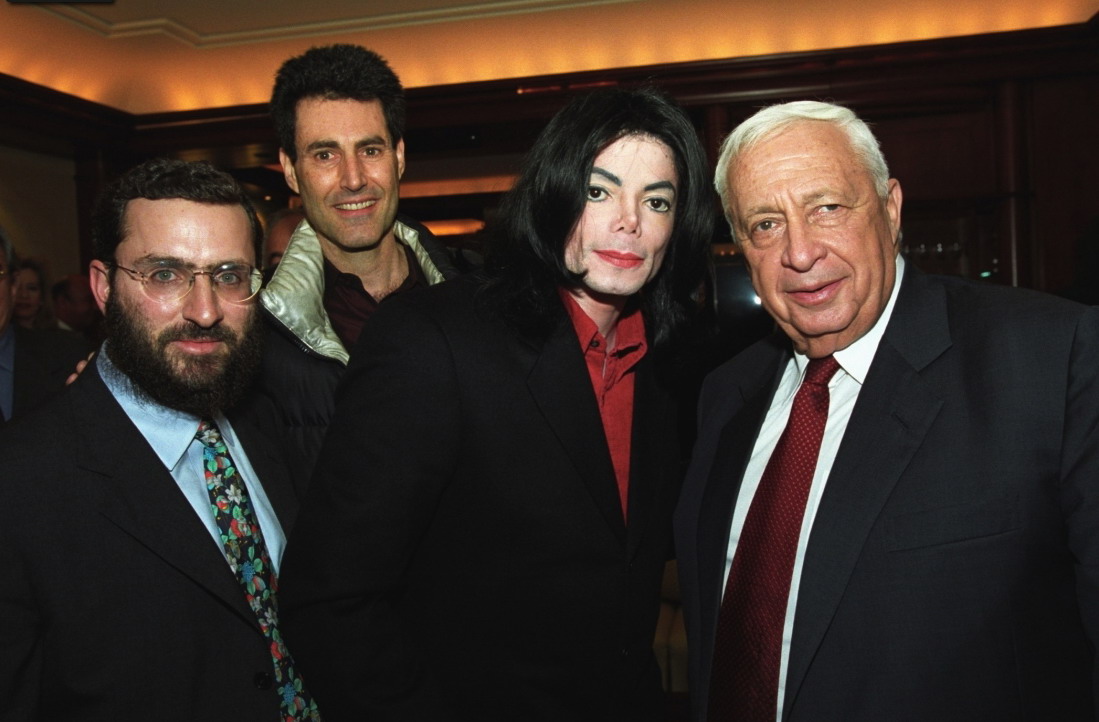
From the right: Prime Minister, MJ, Uri Geller, and the rabbi
In the late part of 2000, a Jewish philanthropist told me that the newly appointed Prime Minister of Israel was his guest. He said it would be good for Israel if Michael Jackson also went to visit the Prime Minister at his home. I invited Michael for this visit, and he said he was very eager to see him up close. Michael’s staff didn’t like the idea. They said that people in some areas—especially in Arab countries—disliked the Israeli Prime Minister. A photo of Michael standing next to him could lead to a ban on selling Michael’s works in those regions. Michael disagreed with them. A few minutes later, we were driving in the car toward the house where the meeting was to take place.
The next day, a photo of Michael with me, our mutual friend Uri Geller, and the Prime Minister was printed around the world. The staff of Michael were right. Many websites said Michael should be boycotted for supporting a hated Israeli leader. But Michael didn’t care. Michael loved Israel and the Jewish people.
Michael was very mindful of the religious sensitivities of my family and respected them. When we were at his home or in a hotel, he ordered halal meals for us from restaurants. He even went himself to halal, well-known restaurants that I had introduced to him.
The text of the speech I prepared for the Oxford University conference based on my conversations with Michael was, at Michael’s request, full of references and wisdom from Judaism (this speech is one of his outstanding achievements; he received standing ovations from the audience, but unfortunately it has not yet been published by his foundation). He felt a sense of kinship with the Jewish people and their teachings as a Jehovah’s Witness.
Michael, who was an African-American, told me that his family had been subjected to racial discrimination for years. Calling Michael a racist is like sprinkling salt on a wound—an injury he never had, neither in his behavior nor in his heart.
(*Elie Wiesel is a writer and political activist, and one of the survivors of the massacres of European Jews. In 1986, he received the Nobel Peace Prize for his works about the massacres of the Jews.)
Source: eMJey.com / Huffington Post