Day 7 of the trial: Michael Jackson — “I’m suffering”
The court yesterday was full of sadness and emotion when the prosecutor played the full audio recording of Michael Jackson’s conversations and once again showed his lifeless image on a hospital bed. This photo and the short version of the audio recording from the first day of the trial had been shown for the first time.
On May 10, 2009—almost a month before Michael’s death—Conrad Murray had recorded Michael’s voice speaking in a calm tone, affected by sedative drugs, as he said these words:
“I’m suffering, you know, I’m suffering.”
After the audio recording finished playing, Michael’s lifeless image was displayed on a large monitor inside the courtroom. According to a prior decision, images that could be shocking to the public would be shown less often, so the media only displayed Michael’s image for a few seconds. However, the photo remained on the courtroom monitor for 2 minutes.
After the photo was removed, Judge Michael Pastor calmly announced it so that the Jackson family—who had been keeping their eyes away from the monitor—would understand.
Stephen Marks, an audio expert in court, testified that the audio recording was made on May 10, 2009, and was found on Murray’s iPhone. He confirmed Michael Jackson’s voice on the recording.
Michael Jackson’s audio recording
In the audio recording played in court, Michael says:
“Elvis didn’t do it. Beatles didn’t do it. We have to be phenomenal. When people leave his show, when people leave my show, I want them to say, ‘I’ve never seen nothing like this in my life. Go. Go. I’ve never seen nothing like this. Go. It’s amazing. He’s the greatest entertainer in the world.’ I’m taking that money, a million children, children’s hospital, the biggest in the world, Michael Jackson Children’s Hospital. Going to have a movie theater, game room”
In a portion of this audio recording that had not been played earlier in court, Michael talks about his concern for sick children around the world and his wish to build a hospital for them—equipped with a movie theater and play areas—so that the children don’t forget their dreams and wishes in the hospital.
“Kids get depressed in the hospital. There’s no place to play and no movie theater. Because they’re depressed, they get sick. Their mind is depressing them. I want to give them that. I care about them, they’re angels. God wants me to do it. God wants me to do it. I want to do it, Conrad.”
Conrad Murray’s voice can be heard on the recording saying, “I know you’re going to do it.”
Michael continues:
“They don’t have enough hope, no more hope. That’s the next generation that’s gonna save our planet, starting with— we’ll talk about it. United States, Europe, Prague. My babies. They grow up without a grandmother. They leave them and they go. — Well (the kids) are traumatized. They run after me (saying) please take me with you.”
(Michael refers to visiting children in orphanages.)
“I want to do that for them.”
“This will be remembered more than my stage performances. My stage performances are here to help the children, and it’s always been my dream. I love them. I love them because I didn’t have a childhood. I had no childhood. I feel their pain. I feel their hurt. I can deal with it. Heal the World, We Are the World, Will You Be There, The Lost Children—these are songs I made because I’m suffering. You know, I’m suffering.”
(13 seconds of silence)
Conrad Murray: Are you okay?
(8 seconds of silence)
Michael: I’m asleep.
You can listen to this conversation on YouTube. (Warning: disturbing content!)
When this recording was played, Jermain Jackson—Michael’s brother—broke down in tears.
On the first day of the trial, prosecutor David Walgren told the court that Michael was under the influence of unspecified drugs when he made these statements.
Frank Dileo’s audio recording
Another audio recording played in court yesterday contained statements by Frank Dileo, Michael’s manager. It was also found on Murray’s iPhone.
Frank Dileo had left this voice message for Murray just 5 days before Michael’s death, in which he suggested that Murray conduct a blood test for Michael so they could see how Michael’s physical condition was.
Frank refers to an incident from the night before rehearsal and says that Michael is sick.
Director of This Is It, Kenny Ortega, had also said on the first day of the trial that Michael was not physically healthy a week before his death. He wrote—almost at the same time as Dileo’s message—in an email to Randy Phillips, CEO of the concert-promoting company:
“This evening he looked tired and weak. He was very cold, he was shaking, and he seemed disoriented. He should be evaluated psychologically.”
On Murray’s iPhone, an email containing medical information about Michael was also found—sent to him by his assistant at the doctor’s office. These documents were being collected to present to the insurance company, which was trying to cancel the insurance contract for the London concerts.
The insurance company was concerned about reports being sent by the media that Michael had been taken home in a wheelchair. The media also claimed that Michael suffered from back pain, lupus, and skin cancer.
In response to the insurance company, Murray wrote that Michael opposed providing medical information to the insurance company. He added:
“Let me tell you that the news being published about his illness is completely baseless.”
Yesterday, other medical documents were shown in court under the alias “Emanuel Arnold,” dated September 2008. These documents state that Conrad Murray had detected signs of insomnia and anxiety in Michael.
Also, data obtained from Conrad Murray’s iPhone confirms that the response to the insurance company occurred at a time when he was treating Michael for insomnia with sedative drugs.
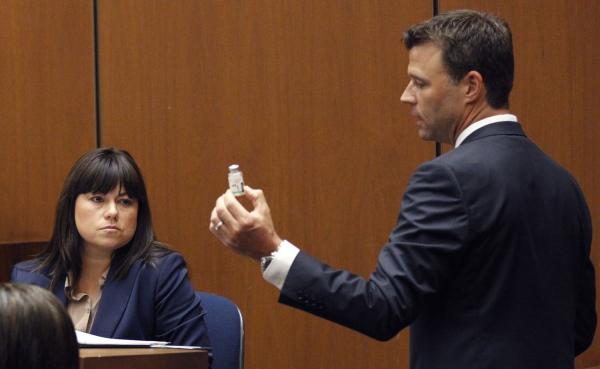
In another development, Elissa Fleak, the Los Angeles medical examiner, testified yesterday about items that had been collected from Michael’s room.
A bag of saline solution that had been opened and an empty 100-milliliter vial of propofol placed inside it were among the items found in Michael’s room. The prosecution says Murray used this device as a substitute for a propofol IV drip—administering the drug into Michael’s vein via an IV drip method. Murray’s defense attorneys say their client had injected only 25 milligrams of this drug into Michael—through a syringe.
Alberto Alvarez, one of Michael’s guards and the person who placed the 911 call, had also testified at the third day of the trial that in Michael’s room there was an opened saline bag hanging on an IV stand, and an empty propofol vial was inside the saline bag. The IV was connected to Michael’s leg by a tube.
On the first day of the inspection of Michael’s room—hours after his death—Elissa Fleak was able to find 12 propofol vials. An empty vial was found at the bottom of Michael’s bed.
Seven medicine bottles were also placed on a table next to the bed, one of which was lorazepam, which Murray had given to Michael.
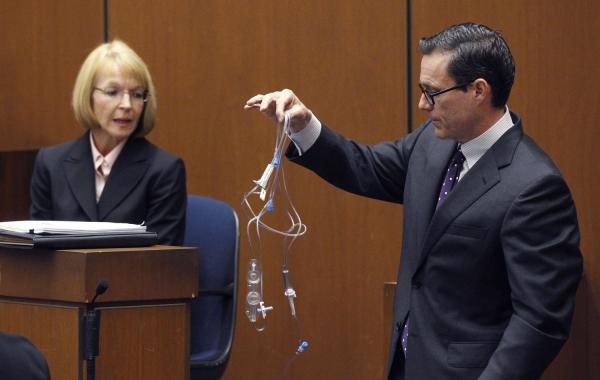
At the start of yesterday’s proceedings, Sally Hirschberg, a sales representative for a medical equipment company, said that when Murray’s doctor’s assistant asked her to send IV injection supplies instead of to the office to a residential apartment in California, she refused and sent those items to Dr. Murray’s office. After Michael’s death, the items were collected from his room by the police.
Hirschberg said that requests for items such as lidocaine and an IV bag for a cardiologist were very strange and unusual.
On June 26—one day after Michael’s death—Hirschberg received a call from Conrad Murray’s office to cancel the request for medical supplies.
Source: eMJey.com / CNN / Reuters