Day 5 of Court: Michael Jackson’s Doctor Wasted His Time on the Phone
Monday marked the fifth day of Conrad Murray’s trial.
Janet, Rebi, Randy, and Jermain were four members of the Jackson family who appeared in court in the absence of the other family members. Michael’s mother and children, along with Jackie, Tito, and Marlon, left Los Angeles for Montreal earlier this week to attend the opening show of Michael Jackson’s Immortal tour. They are expected to return to Los Angeles by next Sunday. On Saturday, they are scheduled to go to Wells to attend the memorial concert for Michael Jackson.
Yesterday, Dr. Rachel Cooper took the stand again. She said that when Michael Jackson arrived at the hospital, there was no chance of bringing him back to life. She said Dr. Murray had not told her anything about propofol, but it wouldn’t have mattered anyway, because Michael had already lost his life long before arriving at the hospital. At 12:57, Dr. Cooper informed the emergency personnel via radio to declare Michael dead; however, Michael was still transported to the hospital. Cooper says Michael Jackson was the first person she tried to revive in the emergency room after she had declared him dead.
“It had never happened that I would declare a patient dead and then have that patient brought to me to be revived.”
Cooper says this had nothing to do with Michael Jackson’s fame, and it was only because the doctor accompanying the patient (Dr. Murray) insisted on doing it.
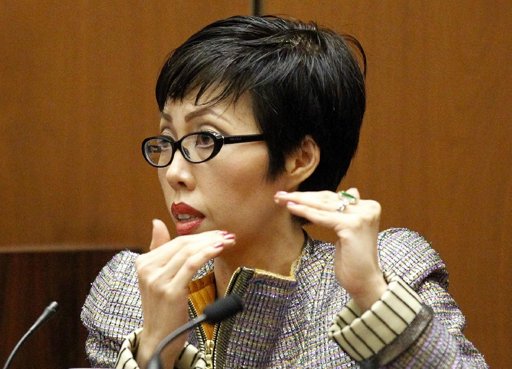
Another emergency doctor, named Thao Gaine, testified that placing a balloon in Michael’s jugular vein was another futile attempt to save his life, and it was done only to mentally prepare Dr. Murray to accept the death of his patient and to allow Michael to leave this world in peace and dignity.
Joan Bandaraz-Pershad, a female doctor from Houston, Texas, said on the stand that she was one of several people Dr. Murray had spoken to by phone on the day Michael died. She said that at 10:20 she called Murray to ask about his instructions regarding one of her patients who was scheduled to undergo surgery at the Houston hospital.
Consuela Angie, a volunteer employee at Dr. Murray’s office in Las Vegas, said that Murray had told them he had taken responsibility for caring for Michael Jackson and was looking for a suitable person to replace him at the office. The records show that Murray had contacted this office at 11:18.
Antonette Gill, another of Dr. Murray’s patients, had called him at 8:49. She said Murray had considered the work for Michael to be a once-in-a-lifetime chance that comes only one time to each person. During her brief conversation with Murray on the day Michael died, Gill asked him to introduce another doctor, but she didn’t receive any proposal.
The prosecutor says Murray left Michael’s room to answer his phone calls.
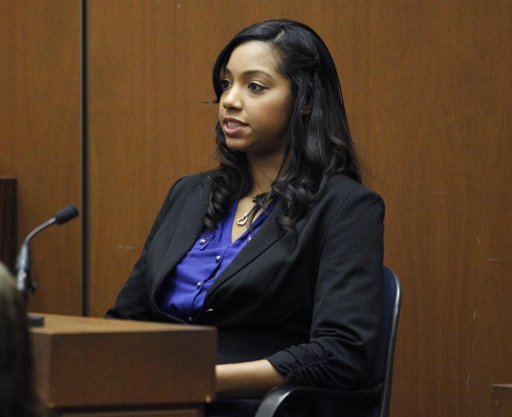
Bridgette Morgan, one of Conrad Murray’s multiple girlfriends, was also among the witnesses on Monday. The judge prevented the prosecutor from entering the private sphere of Morgan and Murray. Morgan had said in January that in 2003 she met Murray at a club in Las Vegas, where Murray was a married man.
Morgan said that at 11:26—30 minutes before Murray realized Michael had stopped breathing—she called him, but she couldn’t speak with him.
Representatives from two telecommunications companies also testified about information obtained from Murray’s phone. The timing of phone calls is considered a key element in proving Murray’s guilt.
The two said that during the hour before the call to emergency services—roughly from 11:20 to 12:20—Murray had been using his phone and had sent a text message.
Source: eMJey.com / CNN.com