Day 17 of the Trial: Details About This Is It
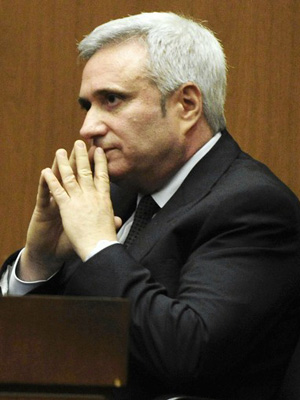
Randy Phillips, CEO of AEG, was also among the witnesses at the seventeenth session of the trial of the defendant accused of involuntary manslaughter in Michael Jackson’s death. AEG was supposed to hold Michael’s This Is It concerts in London.
Phillips spoke about his history of knowing Michael, saying that in 1990, on behalf of Michael’s lawyer, John Branca, he began working with the LA Gear shoe company as Michael’s representative. In that year, Michael was doing advertising for this company.
Phillips said that after that, he didn’t see him again until 2007, when one of Michael’s lawyers named Peter Lopez, on behalf of Paul Gangever, requested a meeting with him in Las Vegas. Gangever had managed Michael’s History tour in 1996 and 1997.
A meeting was arranged by Michael and AEG employees, but it didn’t lead to anything because Michael wasn’t ready to hold a tour at that time.
After that, another meeting was held in late August 2008. At that time, Tom Barrack, the general manager of Colony Capital—which had bought half of Norland—contacted Phil Anschutz of AEG. They met at Colony Capital’s office in Century City, Los Angeles, and discussed having concerts by Michael Jackson between them.
Another meeting was arranged at the Beverly Hills Hotel, during which Dr. Tom, Michael’s then manager, announced that Michael wanted to hold a new tour with new songs. This meeting was followed by phone calls, in-person visits, and negotiations.
In September 2008, Randy Phillips finally met with Michael and Dr. Tom at the Beverly Hills Hotel. They presented plans for Michael’s return to the stage, and Phillips says Michael was very receptive to hearing people’s ideas, and was motivated and full of energy.
Phillips continued that the amount of the salary was never discussed, because Michael was only looking for fresh and creative ideas for his upcoming shows.
In Halloween 2008, another meeting—this time at Michael’s home—was held, during which Michael revealed to Phillips his goal for holding the tour. Providing a fixed place for his children to live comfortably there was the main motivation for Michael to set up this tour.
He wanted to live in a good house in a good location with his three children. Phillips said that Michael used the word “house-sitting” to describe how they lived and said he was tired of that situation.
This conversation was very emotional and made both Michael and Randy cry.
After a meeting in January 2009, a contract for 31 concerts with Michael was signed. Why 31 concerts? Michael wanted to break the record of the black singer Prince, who had held 21 concerts at the O2 Arena.
When ticket sales began and the smoke rose in an instant, they realized that 31 concerts wouldn’t be enough to satisfy the flood of fans. They called Dr. Tom and asked him to ask Michael whether he would be willing to increase the number of concerts, and Michael agreed.
The only condition was that the company find a house for his residence and for his children in the suburbs of London. The house had to have large grounds, a river, and horses, because Michael didn’t want his children locked up in hotel rooms. He wanted his children to be free.
Phillips said: “What he wanted was clear and straightforward: a farm with a river and horses... a country house for his children.”
Another condition was that at the final concert, a representative from Guinness World Records would be present to certify the record of performing 50 concerts in one city under Michael Jackson’s name—a record Michael knew would never be broken.
In March, the budget for the This Is It tour was discussed, and Michael said he wanted his longtime collaborator Kenny Ortega to produce the concerts. Travis Payne became the choreographer, and practical auditions for selecting dancers for the tour began.
In early May, it was that Michael requested that his personal doctor, Conrad Murray, travel with him to London so he could be cared for during the concerts. Michael insisted on this request and said he wasn’t willing to hire another doctor.
At that time, Phillips had no concerns about Michael’s health, but it was the first week of June when he heard that Michael wasn’t eating and had lost weight.
In a meeting, Murray explained that he had prepared a daily protein-rich program for Michael. He also described Michael’s health condition as good.
Phillips also once asked Michael’s personal assistant, Amir Williams, about Michael’s illness, and Amir said Michael had recently returned from Arnold Klein’s office.
In early June, Michael didn’t attend some rehearsal sessions and it seemed he wasn’t focusing enough on the concerts. As the production team moved to London, rehearsal sessions had to be held properly.
What occupied Kenny Ortega was Michael’s focus. His focus was usually extremely high, but on some days it seemed he wasn’t focused.
Phillips once called Michael, but he was told Michael was resting and he couldn’t talk to him.
On June 20, Phillips received an email from Kenny Ortega, who was worried about Michael’s health. After that, a meeting was arranged at Michael’s home with Kenny Ortega, the tour manager Frank Dileo, and Dr. Murray. On that day, Murray was told that it was extremely vital for Michael to focus on his rehearsals. One of the operations that required Michael’s high focus was his flight onto the stage in a three-dimensional outfit!
They learned that Michael had been rehearsing at home with Travis Pice. When Michael returned to them, he told them not to worry because he was ready.
Michael said, “They should build the house so he can install the doors and paint it.”
Kenny Ortega responded, “That’s great! That’s all I wanted to know.”
On June 23 and 24, Michael shined in rehearsals, and at midnight on June 24 he returned home to rest.
The next day, Frank Dileo called Phillips and said Michael had been taken to the hospital. Phillips quickly went to Michael’s home and saw that the ambulance and Michael’s family cars were leaving. He went to the UCLA hospital and stayed there all day.
Prosecutor Walgren asked Phillips whether Michael had failed in rehearsals.
“No, never. We were committed to Michael according to the contract, just as he was committed to us.”
Phillips explained that if Michael wasn’t ready on time to perform the concerts, they would have postponed the tour, but they never thought about canceling it.
Walgren asked about Michael’s behavior and performance in the month he died.
“Like a genius! There is no other artist like him in this world. His attention to detail was incomparable.”
He added that it never even crossed his mind that Michael might not be able to carry out this tour.
Phillips also mentioned Michael’s fatherly behavior toward his children and said he had devoted himself to them—his children were his world.
Phillips said that in the last rehearsal, one day before Michael’s death, when he saw him on stage, the hair on his body stood up.
After the rehearsal ended, Michael walked with him to his car. Michael placed his hands on his shoulders and said:
“You put me into this game, and I’m here now. From here on, it’s with me!”
The lawyers hoped that Randy Phillips would, by portraying a Michael without confidence—anxious and distracted—confirm their theories. But Phillips turned their table over, and the prosecution made the most of his testimony.
Source: eMJey.com / ABC News / LA Times