Day 10 of the Trial: Michael Jackson Was Healthier Than Most People His Age
Yesterday, the prosecutor displayed another photo of Michael Jackson’s lifeless body on a large monitor in front of the jury, and the doctor who had performed Michael Jackson’s autopsy was called to the witness stand.
This doctor said that Michael was healthier than most people his age. He also estimated Michael’s health level as higher than the average in the community among men. He also said it was impossible that Michael Jackson had died from drinking propofol.
In the photo in question, taken one day after Michael’s death, his naked body is shown on a forensic medical examination table. Private parts of his body have been obscured with black tape, and he looks extremely thin.
eMJey.com is excusing itself from showing this photo out of respect for Michael Jackson’s privacy.
Before the photo was shown, the prosecutor warned Catherine Jackson, Michael’s mother, and she decided to leave the courtroom along with other family members. Inside the courtroom, one fan stood up after seeing the photo and left the room. But the other fans remained silent in their seats, hugged one another, and cried.
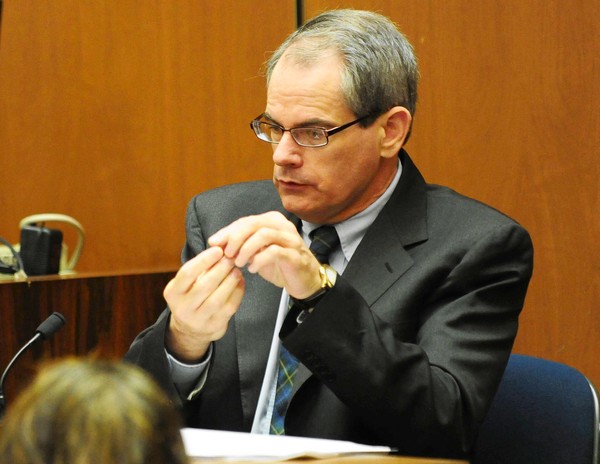
Christopher Rogers said from the stand that in the two minutes Murray claims he left the room, it would have been impossible for Michael to wake up from anesthesia and inject himself with propofol.
“The evidence does not support the theory of self-treatment with propofol.”
“If we were to say that Mr. Jackson personally administered the propofol injection, then we would have to assume that he got up from anesthesia, even though he was simultaneously under the influence of other sleeping drugs. And in that situation, he injected propofol into himself.”
Rogers said Michael’s death was a murder and the cause was propofol.
“He died due to the presence of an excessive amount of propofol in his body, the effect of which was intensified by the presence of other drugs (lorazepam and midazolam).”
Murray had told police that he had injected only 25 milligrams of propofol into Michael. This amount could only put him to sleep for about 5 minutes.
Rogers said police had found an empty 100-milliliter bottle of propofol in Michael’s room.
This doctor also mentioned other drugs found in Michael’s body: midazolam, diazepam, lidocaine, and ephedrine.
The defense lawyers claim that Michael caused his own death by drinking propofol.
Rejecting the defense lawyers’ theory, Rogers said that Michael’s death due to self-treatment with propofol is not likely, and he believes Michael’s death resulted from an accidental overdose of propofol administered by Conrad Murray.
“The goal was to put Mr. Jackson to sleep. The doctor should have introduced the propofol little by little over time into his body. In this case, he would have had to administer an amount of two to three tablespoons of this drug over the course of an hour.”
“We found no measuring device that shows the doctor knew exactly how much of this drug he was putting into Mr. Jackson’s body. In this situation, I think it’s very likely that the doctor made a mistake and injected an excessive amount of the drug.”
“Michael Jackson’s problem was that he couldn’t sleep, and propofol is not a solution to this issue.”
According to experts’ opinions, the testimony of doctor Christopher Rogers is the strongest evidence in the prosecutor’s hands so far.
This doctor also said that at the time of his death, Michael Jackson was a healthy man. Although he was very thin, the ratio between his weight of 136 pounds and his height of 5 feet 9 inches (61.6 kg—175 centimeters) places him in the appropriate range for a 50-year-old man in terms of BMI (body mass index).
Rogers said Michael did not have arteriosclerosis, and his heart was much healthier than that of most men his age. He also said his health was above the average for his age group in society.
The forensic specialist at the Los Angeles medical examiner’s office, in discussing signs of disease in Michael, said he had vitiligo, a skin-color-destroying disease, and an enlarged prostate—something that half of men over 50 develop, and the likelihood of it in men over 80 is 90%.
Michael also had severe inflammation and swelling in his lungs. Inflammation of the joints and intestinal polyps were also observed in him. Michael also had an extra rib at the bottom of his neck. The prevalence of this condition among people worldwide is 0.2%. Vitiligo has a prevalence of about 1 to 2 percent worldwide.
In court, Christopher Rogers said that inside Michael’s mouth, esophagus, and stomach, there was no trace of the white-colored propofol drug.
Another theory from the defense lawyers was the possibility that Michael died from taking lorazepam pills and drinking propofol at a time when Dr. Murray was not in the room.
Toxicology confirmed that the amount of lorazepam present in Michael’s stomach was more than the amount in his blood.
Rogers said from the stand that it was likely lorazepam was ingested, but propofol was the cause of death.
Murray personally admitted that over 10 hours he had given Michael various medications, including lorazepam.
Rogers confirmed the prosecutor’s theory that Murray used an IV bag to inject propofol into Michael and said this technique likely failed when Murray was not watching his patient.
The propofol bottle that the prosecution claims was placed inside the IV bag had a crack in the cap that appeared to have been made with a medical pin. Rogers said:
“It’s possible that Murray inserted a pin into the rubber cap of the propofol bottle, and therefore the medication inside would have come out drop by drop until the last drop.”
Of course, during questioning by the defense attorney, Rogers accepted that if Michael could have touched the IV line connected to his knee, then by pressing it he could have introduced a large amount of propofol into his body—resulting in immediate cardiac arrest.
However, when he then answered the prosecutor, Rogers said that Michael’s death counts as murder even if he himself injected the propofol, because the mistake was made by the doctor who left his patient alone with this medication.
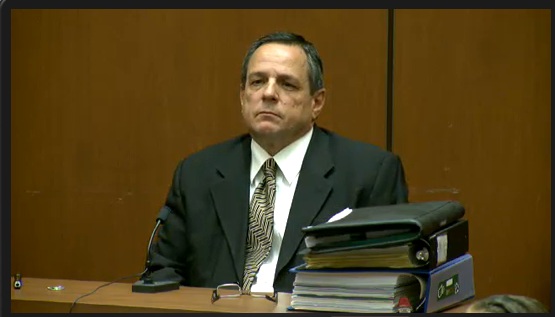
Lieutenant Scott Smith of the Los Angeles Criminal Investigation Bureau was another witness yesterday. He said the police office ran into problems with the medical examiner’s office regarding the interrogation of Dr. Arnold Klein because both offices had undertaken this task, which caused interference. Smith said they asked the medical examiner’s office not to interrogate Arnold Klein.
Police then instructed the Drug Enforcement Administration to conduct an investigation into Arnold Klein. Smith said this doctor was never prosecuted for treating Michael Jackson.
Smith, who was responsible for interrogating Conrad Murray—and the video of this interrogation had been shown earlier in court—said that when, at the end of the interrogation, they told Murray that three drug bags had not yet been collected from Michael’s room, his eyes widened even more in surprise.
Source: eMJey.com / CNN / Washingtonpost